

In the world of high-stakes banking, the “Kitchen Sink” year is a rare moment of corporate courage.
By choosing to front-load ₦748 billion in impairment charges, the Board and Management of First HoldCo PLC have essentially cauterized a decade of legacy wounds.
While the 92% drop in headline profit makes for a jarring front page, the underlying mechanics reveal a bank that is finally prioritizing structural health over cosmetic earnings.
This aggressive provisioning—driven by the Central Bank of Nigeria’s (CBN) mandate to end the “forbearance era”—clears the decks.
By flushing out delinquent COVID-era loans and insider-related exposures that haunted the previous administration, First HoldCo is no longer running a race with lead in its shoes. It enters 2026 with a “fortress balance sheet” ready to compete in a recapitalized industry.
Debt Recovery: Signaling a New Era of Accountability
First HoldCo’s management has pivoted from passive provisioning to active pursuit of delinquent borrowers. Ongoing recovery efforts have sent a clear message to the Nigerian credit market: the era of “soft” enforcement is over. This “determination to collect” is designed to restore depositor confidence and deter future credit defaults.
Recoveries from previously written-off loans flow directly into the bottom line as “other income.” Analysts expect these aggressive collection efforts to provide a significant, high-margin boost to earnings in 2026 and beyond.
Ready for Takeoff: NPLs Down, CAR Up
With the “heavy lifting” of the balance sheet repair largely complete, the bank’s core metrics have reached a turning point:
- Statement of Financial Position: First HoldCo has materially repaired its foundations. A sharply reduced Non-Performing Loan (NPL) ratio and a bolstered Capital Adequacy Ratio (CAR) mean the bank is no longer constrained by legacy liabilities.
- Deployment Capacity: With its capital buffers restored, the bank is now positioned to “fly”—aggressively expanding its loan book and investing in digital infrastructure to compete with both Tier-1 rivals and nimble fintech challengers.
Legacy Liquidation: Ending the Era of Insider Risk
The Femi Otedola (Chairman Board of Directors) -led era of First HoldCo Plc is defined by a departure from the “SOL” (Single Obligor Limit) breaches that once plagued the institution:
- The Turnaround: Under previous leadership, non-performing loan (NPL) ratios peaked at a staggering 24.7% (2018), fueled by concentrated oil and gas exposure. By 2025, even after the aggressive clean-up, the ratio sits at a manageable 7%.
- Regulatory Forgiveness Ends: The ₦748 billion impairment is a direct response to the CBN’s demand that banks stop “hiding” bad loans under the guise of forbearance. By taking the hit now, First HoldCo avoids the “death by a thousand cuts” that comes from multi-year incremental provisioning.
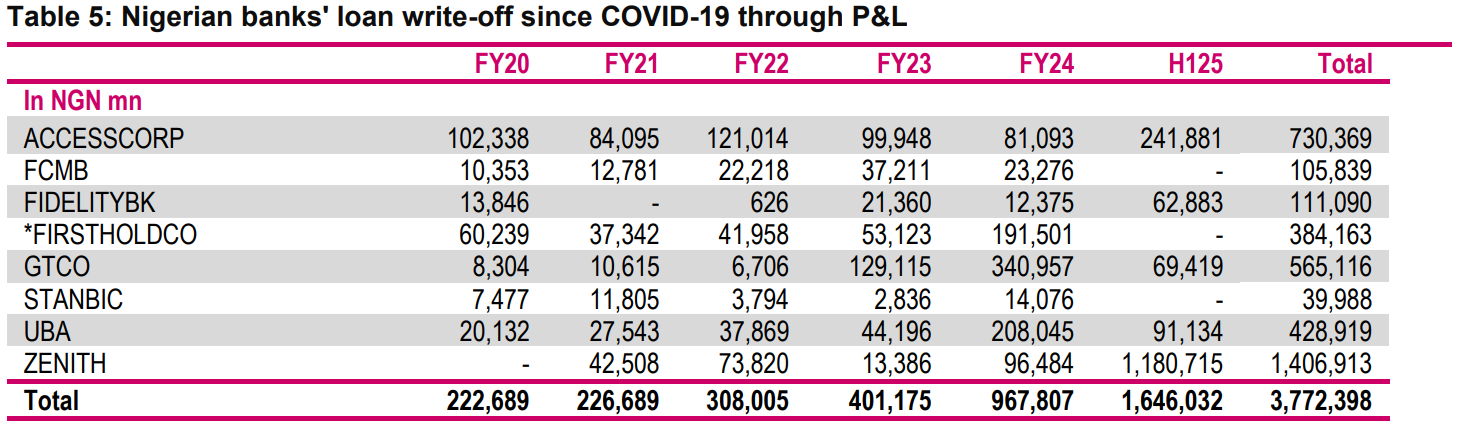
- Tier-1 Comparison: Despite the shock, Renaissance Capital data shows First HoldCo had the lowest cumulative write-offs among Tier-1 peers (Zenith, Access, GTCO and UBA) between 2020 and 2025, suggesting that the underlying credit culture has actually been more resilient than market perception (see chart below from Renaissance Capital Africa).
A “Real Sector” Powerhouse: Lending Where it Matters
While many Nigerian banks have become “glorified hedge funds”—parking cash in zero-risk government securities—First HoldCo remains a primary engine of the Nigerian economy:
- High Loan-to-Asset Ratio: At 33.56%, First HoldCo’s ratio is significantly higher than its Tier-1 peers. It has deployed ₦9.06 trillion into the real sector, choosing to support Nigerian businesses despite a volatile FX and inflationary backdrop.
- Earnings Giant: The core business remains incredibly profitable. Interest income surged 23.6% to ₦2.96 trillion, while net interest income jumped 36.3%. This “earnings power” provides the massive cushion necessary to absorb nearly a trillion Naira in impairments and still remain profitable at the operating level.
Operational Efficiency: Managing the “Bricks and Mortar” Moat
First HoldCo’s cost structure reflects the reality of maintaining Nigeria’s most extensive physical banking infrastructure:
- Staff and Tech: Personnel expenses rose a modest 25%—trailing the 2025 inflation peak—showing disciplined talent management in a competitive “Japa” era where skilled workers are at a premium.
- The Cost of Banking: Between the ₦113.4 billion AMCON levy and ₦151 billion in maintenance, the bank is paying a high “regulatory and physical tax.” However, this network is also its greatest asset, providing a low-cost deposit base that large-cap rivals struggle to replicate.
The Otedola Intervention: Reversing First HoldCo’s Decade of Decay
The ascent of billionaire activist investor Femi Otedola to the Chairmanship of First HoldCo PLC marks the end of a turbulent chapter characterized by systemic “value destruction.”
Before the 2021 boardroom upheaval, Nigeria’s oldest lender was teetering under the weight of a massive non-performing loan (NPL) crisis, fueled by insider-related lending and a concentrated exposure to the volatile oil and gas sector.
The intervention by the Central Bank of Nigeria (CBN) in April 2021, which saw the removal of then-Chairman Obafemi Otudeko and First Bank Chair Ibukun Awosika, served as the definitive “stop-loss” for a bank that had effectively become a captive lender for entrenched interests.
The NPL Crisis: A Legacy of Bad Debt
During the mid-to-late 2010s, First HoldCo’s asset quality became a cautionary tale for institutional investors:
- The 24% Threshold: Gross NPL ratios escalated to dangerous levels, hitting 24.4% in 2016 and peaking at 24.7% in 2018. This meant nearly a quarter of the bank’s total loan book was effectively underwater.
- Sector Concentration: The bank was disproportionately exposed to delinquent loans within the troubled oil and gas sector, leaving it vulnerable to global commodity price shocks.
- Capital Erosion: The persistent need to provision for these bad loans starved the bank of the capital necessary for digital innovation, allowing leaner Tier-1 rivals to seize market share.
Regulatory Crackdown: The “Insider Loan” Scandal
The 2021 leadership purge was triggered by what the CBN described as “material non-compliance” regarding insider-related credit:
- Defying the Regulator: A 2020 target examination revealed that the bank had ignored regulatory reminders for over three years to perfect liens on shares and collateral arrangements for restructured insider loans.
- The “Cleaning House” Mandate: The CBN’s decisive action was intended to protect the stability of the Nigerian financial system, as First Bank’s systemic importance made its governance failures a national risk.
- Otedola’s Entry: Otedola began quietly accumulating shares in 2021, eventually emerging as the majority shareholder and leading a new board focused on transparency and the total recovery of the group’s reputation.
The Path to Recovery: De-Risking the Future
The current “kitchen sink” approach to the 2025 results, including the ₦748 billion impairment charge, is the final stage of this multi-year cleanup:
- Restoring Discipline: By shifting the NPL ratio from the mid-20% range under the old guard to a stabilized single-digit figure today, the new management has successfully de-risked the balance sheet.
- Institutional Trust: The removal of insider-related friction has paved the way for First HoldCo to participate in the 2026 recapitalization from a position of transparency rather than evasion.
Core Strength: First HoldCo’s ₦2.9 Trillion Revenue Engine Defies Macro Headwinds
While a “kitchen sink” approach to impairments dominated the headlines, the underlying 2025 financial results for First HoldCo Plc reveal a formidable earnings machine.
The group generated a staggering ₦2.96 trillion in interest income, a 23.6% surge that underscores its massive footprint in the Nigerian credit market. By successfully containing interest expenses, the bank widened its margins, demonstrating significant operational leverage even in a high-inflation environment.
Margin Expansion: Net Interest Income Surges 36%
The standout feature of the 2025 P&L was the bank’s ability to manage its cost of funds:
- The Yield Gap: While interest income grew by double digits, interest expenses rose a mere 5.7% to ₦1.05 trillion.
- The Net Result: This discipline propelled net interest income (NII) to ₦1.91 trillion, a 36.33% increase from 2024.
- Non-Interest Streams: Fee and commission income provided a reliable secondary engine, climbing 16.2% to ₦354 billion, as the bank leveraged its vast retail network for transaction-based revenue.
The Fair Value Swing: A ₦600 Billion Headwind
Profitability faced a major technical hurdle due to a sharp reversal in the valuation of financial instruments:
- Valuation Hit: The group booked a fair value loss of ₦87 billion, a dramatic swing from the ₦549.98 billion gain recorded in 2024.
- Paper vs. Cash: This ₦636 billion delta acted as a massive “non-cash” dampener on the bottom line, masking the operational strength of the core banking business.
Operational Realities: Managing Nigeria’s Largest Network
Operating in the Nigerian market requires navigating high regulatory and infrastructural costs:
- Controlled Personnel Growth: Despite a fierce “war for talent” against fintechs, personnel expenses rose 25% to ₦385.9 billion, notably staying below the peak inflation rate of 2025.
- The Infrastructure Tax: Maintaining Africa’s most extensive branch network cost the bank ₦45.5 billion in power and light, and ₦151 billion in maintenance.
- Regulatory Levies: Government-mandated costs remained a heavy burden, with the AMCON levy (₦113.35 billion) and NDIC premiums (₦67.7 billion) accounting for a significant portion of the ₦809.3 billion in other operating expenses.
A Unified Front: The “First” Brand Consolidation
The 2025 rebranding by First HoldCo was more than a cosmetic update; it was a structural necessity to harmonize the group’s global and local presence:
-
Branding across locations: By pivoting all entities—from insurance to merchant banking—under the “First” moniker, the group resolved material brand conflicts that had previously complicated cross-border business and multi-location operations.
-
Synergy Play: The unified brand identity is expected to lower customer acquisition costs and improve cross-selling opportunities across the HoldCo’s diversified financial services ecosystem.
Tax and Terminal Profit
Despite the heavy impairment charges and fair value losses, the group remained profitable at the operating level:
- The Tax Man Cometh: First HoldCo paid ₦176.34 billion in taxes, a reflection of its strong pre-provision profitability.
- Final Takeaway: Operating profit stood at ₦228.3 billion, which, after the massive tax bill, left a net profit from continuing operations of ₦52.75 billion.
Conclusion
While a 92% profit contraction typically triggers alarm on news and trading desks, the surgical precision with which First HoldCo management dismantled its legacy debt mountain in 2025 deserves a different label: Strategic Fortification.
The “clean-up” was only possible because the underlying bank is an earnings powerhouse. Management should be lauded for using its massive ₦1.91 trillion Net Interest Income as a “shock absorber.”
By choosing to “kitchen sink” the balance sheet now, the board has traded a single year of optical volatility for a decade of institutional stability.
In the high-stakes environment of Nigerian banking, where the Central Bank (CBN) is demanding ₦500 billion in minimum capital for Tier-1 status by 2026, First HoldCo has effectively cleared the debris before the new race begins.
The board’s decision positions First HoldCo as a “clean” investment for global and domestic institutional and retail capital market investors.
 Follow the MoneyCentral Nigeria channel on WhatsApp: Click here!