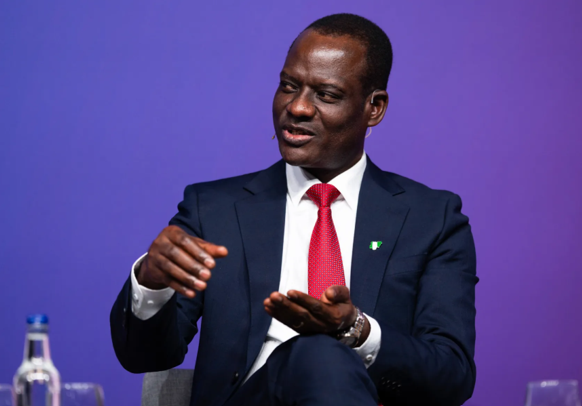



Nigeria is targeting an investment-grade credit rating and a return to JPMorgan Chase & Co.’s flagship emerging-market government bond index as it seeks to draw more investment and deepen its capital markets, Finance Minister Taiwo Oyedele said.
The government is also working with MSCI Inc. to have Nigerian equities included in its gauges, Oyedele said at an event where the Securities and Exchange Commission (SEC) unveiled a 10-year capital-markets plan on Monday.
“Our ambition has to be bold,” he said in Abuja, the capital. “What we’re looking for is investment grade within the next three years.”
The targets underscore President Bola Tinubu’s push to improve Nigeria’s standing with investors after years of foreign-exchange shortages and restrictions made it difficult for overseas investors to repatriate funds.
Moody’s Investors Service asesses the nation’s debt at six levels below investment grade, while it’s five below at S&P Ratings and two under at Fitch Ratings.
FTSE Russell restored Africa’s biggest oil producer to frontier-market status in September, making its stocks eligible for inclusion in the FTSE Frontier Index.
Nigeria’s naira-denominated government bonds were admitted to JPMorgan’s GBI-EM indexes in 2012 before being removed in 2015 following foreign-exchange restrictions and concerns about market liquidity.
Oyedele made his comments after the SEC said it’s working to triple the size of Nigerian capital markets over the next decade.
The master plan through 2036 targets increasing the capital market to 750 trillion naira ($563 billion) by then from about 250 trillion naira now, SEC Director-General Emomotimi Agama said.
Oyedele said the government’s ambition is even greater than the target contained in the plan.
“What we are aiming at has to be at least $1 trillion for the capital markets in 10 years,” he said.
The SEC’s strategy, developed with Nairobi-based development agency FSD Africa and funded by the UK government, includes a goal of more than doubling annual diaspora investment in the capital markets to $10 billion.
It also seeks to increase assets managed by collective investment funds 10-fold to $56 billion.
It was launched alongside a national savings scheme bolstered by tax incentives, with the Nigeria Revenue Service and FSD signing a memorandum of understanding on the plan on Monday, Agama said.
“Too few Nigerians own a share, a bond or a unit in a collective investment scheme,” Agama said. “Too much of our savings sits idle, outside the formal system, quietly eroded by inflation. And too many of our enterprises, our infrastructure projects and our states still look abroad, or to the banks alone, for capital that ought to be raised from Nigerians, for Nigeria.”
The nation’s stocks index is the world’s best performer this year, climbing 71% in dollar terms.
The Nigeria exchange or NGX is bracing for the listing of Dangote Petroleum Refinery and Petrochemicals FZE in what would be Africa’s biggest initial public offering to date.
The Lagos-based oil-processing complex owned by Africa’s richest man, Aliko Dangote, plans to raise as much as $2.1 billion, valuing the business at close to $50 billion.
 Follow the MoneyCentral Nigeria channel on WhatsApp: Click here!