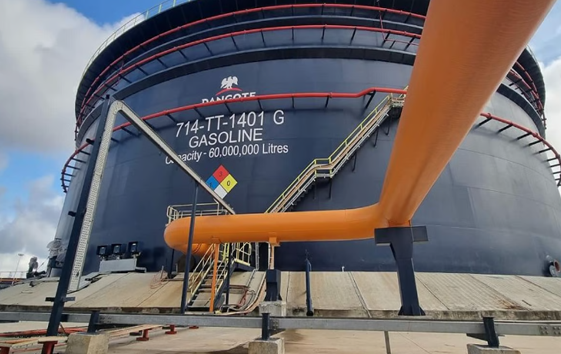



The unglamorous, highly technical business of refining crude oil into everyday transportation fuels has emerged as the most profitable segment of the global energy sector.
This has minted billions of dollars in profit for Global refiners including Nigeria’s Dangote Refinery.
While upstream crude drillers typically capture the lion’s share of financial headlines, a quiet revolution has played out across the global energy landscape.
In the United States, the three largest pure-play independent refiners—Valero Energy, Marathon Petroleum, and Phillips 66—have surged into the top third of the S&P 500 by market value.
This represents a stunning reversal for an industry that historically operated on paper-thin margins.
The primary catalyst for this downstream windfall is a structural global refining deficit.
Geopolitical conflicts on the “wrong side” of the Strait of Hormuz, Ukrainian drone attacks targeting Russian processing hubs, and Beijing’s tight restrictions on refined product exports have collectively removed roughly 5 million barrels per day (bpd) of processing capacity from the global grid—equivalent to a 5% supply contraction.
With inventories sitting at critical multi-year lows, the benchmark U.S. Gulf Coast 3:2:1 crack spread recently topped $61 a barrel, easily outpacing the 2022 bonanza average of $40 a barrel.
The U.S. Gulf Coast (USGC) 3:2:1 crack spread is a theoretical refining margin that measures the profitability of turning 3 barrels of crude oil into 2 barrels of gasoline and 1 barrel of distillate fuel (like diesel or heating oil).
Dangote Rewrites the West African Fuel Playbook
On the other side of the Atlantic, the newly built 650,000 bpd Dangote Petroleum Refinery in Lagos, Nigeria, is demonstrating identical margin-capturing power. The megaproject has rapidly established itself as one of the world’s most lucrative downstream assets, printing a striking 23% EBITDA margin last year.
However, operating in an emerging economy brings unique currency challenges. To protect its balance sheet from severe foreign exchange risks, the refinery has abandoned its domestic naira-denominated pricing model.
The facility has fixed its ex-depot Premium Motor Spirit (PMS) price at $0.779 per litre, alongside $1.087 per litre for diesel and $0.942 per litre for aviation fuel.
This transition to hard-currency transactions is designed to align product revenues directly with the currency used to procure its crude feedstock.
Dangote continues to buy a significant portion of its crude oil imports in U.S. dollars, creating an unsustainable balance sheet mismatch when selling finished products in highly volatile Nigerian naira.
Furthermore, as the company prepares for its highly anticipated Initial Public Offering (IPO) later this year, establishing a reliable, dollar-hedged cash flow model is vital to securing premium valuations from international institutional investors.
Capping Regional Fuel Arbitrage
As the largest single supplier of refined products in West Africa, Dangote’s domestic pricing strategy has exerted immense influence across regional trading hubs, effectively serving as a pricing cap.
Market participants (Platts) reported that on July 14, rising flat prices on the international market triggered widespread anxiety among African fuel importers.
Because Dangote’s massive domestic output caps fuel costs within Nigeria, adjacent Lome import values have risen well above Dangote’s ex-depot sales prices. This price gap has successfully shut the regional arbitrage window, locking out foreign blended imports.
In contrast, Ghanaian spec gasoline continues to command a steep premium, keeping the trade pipeline open for international suppliers.
With the Dangote megacity plant now setting the baseline price for West African fuels, both international refiners and domestic distributors must adjust to a reality where the region’s physical oil balances—and margins—are dictated directly from Lekki, in U.S. dollars.
 Follow the MoneyCentral Nigeria channel on WhatsApp: Click here!