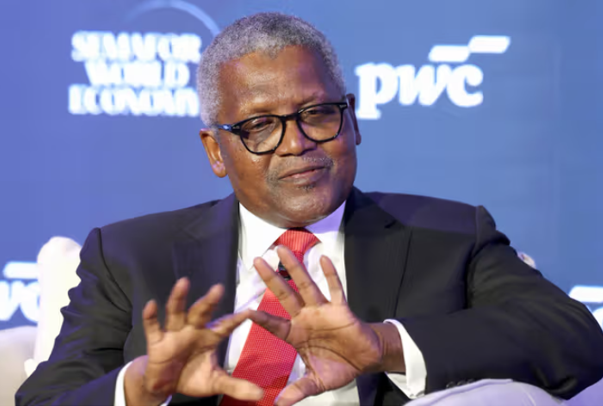



The Dangote Petroleum Refinery and Petrochemicals complex has established itself among the world’s most profitable downstream assets, printing a striking 23% EBITDA margin last year according to people with knowledge of the company’s finances.
The blockbuster profitability figures emerge just as the mega-refinery advances plans to raise as much as $2 billion in what would be Africa’s largest-ever initial public offering (IPO). The impending debut has triggered an unprecedented investor frenzy across Nigeria, cutting through institutional asset managers down to first-time retail accounts.
Highlighting the intense interest among Nigeria’s financial elite, billionaire tycoon Femi Otedola revealed he is preparing a $100 million anchor investment. “I have appealed to Dangote,” Otedola said at a briefing at the Refinery complex attended by MoneyCentral, noting he requested Aliko Dangote to allocate him the $100 million stake through a private placement ahead of the public listing.
The Margin Sustainability Question
While a 23% margin places Dangote at the absolute peak of global refining efficiency, equity strategists warn that whether these returns prove durable remains a high-stakes open question.
The facility has operated at commercial scale for only a brief window and has yet to navigate a full, unshielded commodity cycle. Downstream refining margins are historically highly cyclical and vulnerable to swift compressions driven by shifting global crude prices, local regulatory adjustments, and evolving fuel demand.
Furthermore, some of the refinery’s recent earnings momentum was supercharged by geopolitical anomalies. Severe supply-chain disruptions and shipping re-routings linked to the conflict in the Middle East created structural arbitrage windows that favored large Atlantic basin processors.
Aliko Dangote candidly acknowledged this macro tailwind in a recent interview with Nicolai Tangen, CEO of Norges Bank Investment Management, stating that the crisis in the Middle East had been “beneficial” for the combined refinery, fertilizer, and petrochemical operations.
A Generation-Defining Market Test
The planned $2 billion share float on the Nigerian Exchange will serve as a definitive litmus test for domestic and regional capital depth. Absorbing a multi-billion-dollar industrial asset requires deep, sustained liquidity that will push the boundaries of local pension funds and international frontier-market allocations alike.
Should the asset successfully preserve its top-tier margins as global supply chains normalize, it will fundamentally redefine corporate equity valuations across sub-Saharan Africa.
A successful IPO that values the asset in the $40 billion range, will see the Nigerian Exchange (NGX) leapfrog Morocco’s Casablanca Stock Exchange to become the second-largest equity market in Africa.
According to data compiled by MoneyCentral, South Africa’s Johannesburg Stock Exchange (JSE) maintains its long-standing, dominant pole position with a market capitalization of $1.52 trillion. However, a spectacular 51% year-to-date rally has pushed the total value of the NGX up to $111.5 billion, neck and neck with Morocco’s $114 billion valuation as international capital targets structural reforms in West Africa.
The Bottom Line: Dangote Refinery has proved its engineering and initial margin capabilities, outperforming global peers on an EBITDA basis. However, as the company transitions toward its historic $2 billion IPO, public market investors must differentiate between long-term operational efficiency and transient geopolitical tailwinds. Otedola’s $100 million bid signals absolute local confidence, but international capital will demand proof that a 23% margin can survive a cooling commodity market.
Dangote Refinery vs USGC, Indian, Asian, Middle East Refiners: margins and comparative performance table
| Region / Refiner | EBITDA Margin (report) | Crack Spread / Margin (Q1 2026, $/bbl) | Notes & Source |
|---|---|---|---|
| Dangote Refinery (Nigeria) | ~23% EBITDA margin (last year) [Bloomberg] | Gasoline: ~$28.3/bbl (Mar 2026) Diesel: +$14.5/bbl advantage over USGC (Feb 2026) Jet/ATK: ~$99/bbl (vs USGC ~$64/bbl) [~55% premium] |
Operated at commercial scale briefly; Middle East disruptions supportive |
| US Gulf Coast (USGC) – Avg. independent refiners | ~15–18% EBITDA (Q1 2025 industry average) [CSI Market, OGJ] | Gasoline: ~$29.1/bbl (Mar 2026) ATK: ~$64/bbl (Mar 2026) Diesel: lower than Dangote by ~$14.5/bbl in Q1 |
High complexity, global benchmark; margins falling in Q1 2025 ogj+1 |
| Marathon Petroleum (USGC) | ~17–19% EBITDA (typical 2024–2025) | Comparable capacity: 631 Mbpd Galveston Bay, 606 Mbpd Garyville | USGC benchmark assets |
| Motiva Enterprises (Port Arthur) (USGC) | ~16–18% EBITDA | 730 Mbpd Port Arthur Refinery | USGC benchmark asset |
| ExxonMobil (Beaumont) (USGC) | ~16–18% EBITDA | 603 Mbpd Beaumont Refinery | USGC benchmark asset |
| Asia (Singapore Cracking) | ~12–15% EBITDA (regional average 2024) | Singapore crack spreads lower than Dangote jet fuel premium | Regional benchmark; Singapore cracking |
| India (Reliance/Jio-bp) | ~14–17% EBITDA (large Indian refiners) | Competitive diesel margins, but lower jet fuel spreads than Dangote | Large integrated Indian refiners |
| Middle East (Saudi Aramco refineries) | ~18–20% EBITDA (integrated Middle East) | Cracking margins competitive, but no显示的 jet fuel premium like Dangote | Middle East integrated refiners |
US Gulf Coast (USGC). Source: MoneyCentral Research
 Follow the MoneyCentral Nigeria channel on WhatsApp: Click here!