



On June 11, 2026, the Central Bank of Nigeria (CBN) released two sweeping exposure drafts that dismantle the decade-old structural architecture of the country’s largest financial conglomerates.
Signed by Dr. Rita I. Sike, Director of Financial Policy and Regulation, the Revised HoldCo Guidelines and the Guidelines on Ring-Fencing of Closely Linked Entities represent a paradigm shift aimed at isolating commercial banks from group-level contagion.
However, the cost of this safety is a severe capital shortfall, estimated by analysts at Zrosk Investment Management, as an aggregate ₦326 billion across existing tier-1 holding companies, alongside a fundamental threat to the economic logic of the “financial supermarket” model.
The 20% Buffer: A Costly Capital Gap
Under the extant 2014 framework, a financial holding company’s (HoldCo) paid-in capital—defined strictly as share capital plus share premium—was merely required to exceed the aggregate paid-in capital of its subsidiaries. The new guidelines introduce an uncompromising standalone buffer.
This 20% premium instantly puts every active Nigerian banking HoldCo in regulatory breach.
The compounding effect is severe. Because the CBN has forced banks to complete massive capital raises to meet the new ₦500 billion international banking floor, the subsidiary aggregate has ballooned, automatically widening the HoldCo compliance gap.
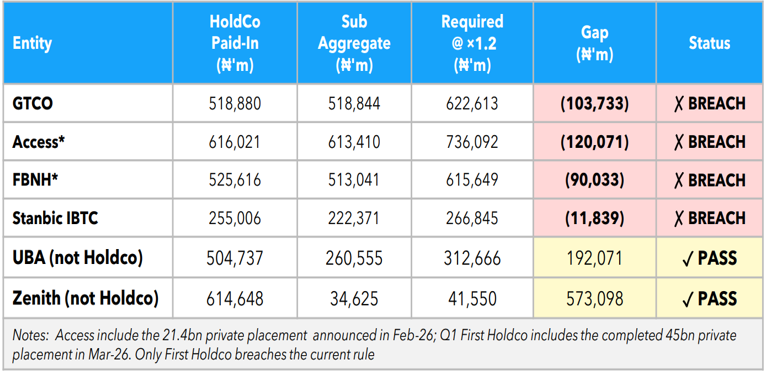
For institutions that previously resisted the HoldCo model, the regulatory grace period has ended. The draft’s mandate that closely linked entities “shall incorporate” a non-operating HoldCo directly targets Zenith Bank and United Bank for Africa (UBA).
While structurally heavy, the forced reorganization could be a massive medium-term catalyst for UBA.
Currently, UBA Nigeria directly houses 22 subsidiaries across 20 African countries. Moving these offshore assets out of the commercial bank and up to a new HoldCo structure—while operationally complex, requiring regulatory nods across 21 jurisdictions—creates the optionality to list subsidiaries independently, optimize segment disclosures, and unlock the hidden valuation of UBA’s vast pan-African footprint.
For existing HoldCos, the re-routing of offshore subsidiaries is equally disruptive. The CBN requires all foreign banking assets to sit directly under the HoldCo or an intermediate holding structure, rather than the domestic bank.
This cleanly de-risks the domestic depositor base, but saddles HoldCos with transaction taxes, capital gains tax, and currency settlement friction within a six-month transition window.
Re-examining Cross-Sell Economics
Beyond capital metrics, the “Ring-Fencing” draft strikes at the very heart of the integrated banking model. In recent years, Nigerian banks aggressively built fintech, payments, pension, and asset management platforms to capture ecosystem synergies.
The new rules mandate strict IT and data separation. Related entities are barred from sharing core technology infrastructure, meaning fintech arms like GTCO’s HabariPay or Access’s Hydrogen must build independent core transactional, reconciliation, and payment engines.
Even more damaging is the customer “re-onboarding” requirement. Any client referred from a bank to an affiliate must go through fresh KYC verification, give express data consent, and open a distinct wallet or account. This adds friction, destroys cross-selling margins, and elevates Customer Acquisition Costs (CAC), eroding the valuation premium long granted to diversified financial conglomerates.
Valuations and Outlook
The market is already pricing in these friction costs. While FirstHoldCo’s aggressive proposal to raise capital up to a ₦1 trillion paid-up base signals high-end ambition, the near-term dilution from bridging its ₦90 billion HoldCo gap is real.
Across the board, banking stocks are likely to experience pressure as institutional investors digest the dilutive impact of ₦370 billion in secondary public offerings and rights issues.
Ultimately, the CBN is forcing a transition from capital-efficient conglomerate leverage to deeply ring-fenced standalone entities.
For long-term investors, the resultant transparency will likely earn these institutions a “governance premium” over time. But over the next 12 to 18 months, the sector must navigate a complex landscape of capital dilution, restructuring costs, and tech rebuilds, testing the limits of shareholder patience.
 Follow the MoneyCentral Nigeria channel on WhatsApp: Click here!