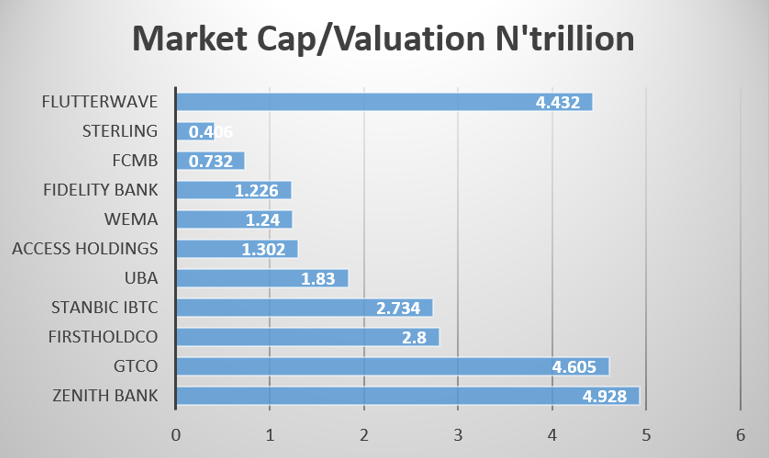



Nigerian payments unicorn Flutterwave, which received a strategic investment from Ripple at a N4.432 trillion ($3.2 billion) valuation, is now larger than 8 of the 10 largest Nigerian banks by market capitalization, signaling the fintech sector’s rapidly ascending stature in Africa’s most dynamic financial ecosystem.
Flutterwave’s ₦4.432 trillion valuation premium highlights a profound shift in market perception, as international private equity capital increasingly values transaction velocity and scalable digital infrastructure over heavy physical balance sheets and high branch networks.
Flutterwave vs. Nigerian banks valuation comparison
| Company | Valuation/Market Cap (N) | Status vs. Flutterwave |
|---|---|---|
| Flutterwave | N4.432 trillion | — |
| Zenith Bank | N4.928 trillion | Larger (4.93% above Flutterwave) |
| GTCO | N4.6 trillion | Larger (3.6% above Flutterwave) |
| FirstHoldCo Plc | N2.8 trillion | 36.8% smaller |
| Stanbic IBTC | N2.734 trillion | 38.3% smaller |
| UBA | N1.83 trillion | 58.7% smaller |
| Access Holdings | N1.302 trillion | 70.2% smaller |
| Wema Bank | N1.24 trillion | 71.9% smaller |
| Fidelity Bank | N1.226 trillion | 72.3% smaller |
| FCMB | N732 billion | 83.5% smaller |
| Sterling Bank | N406 billion | 90.9% smaller |
Flutterwave’s N4.432 trillion valuation is now bigger than FirstHoldCo Plc which has a market cap of N2.8 trillion, Stanbic IBTC N2.734 trillion, United Bank for Africa (UBA) N1.83 trillion, Access Holdings N1.302 trillion, Wema Bank N1.24 trillion, Fidelity Bank N1.226 trillion, FCMB N732 billion and Sterling bank N406 billion, according to data compiled by MoneyCentral.
Only Zenith Bank with market cap of N4.928 trillion and Guaranty Trust Holding Company (GTCO) at N4.6 trillion is bigger although Flutterwave is closing in fast on them too.
Flutterwave’s Banking license may squeeze banks further
Flutterwave Inc., announced in April 2026 that it had secured a Nigerian banking license, which would mean more competition with traditional banks.
This license enables the company to hold funds and deposits directly, strengthening its financial infrastructure across its largest market and enabling more efficient financial services and settlement flows for consumers, businesses and enterprises.
By securing this banking license, Flutterwave gains greater control over how funds move within its ecosystem, including the ability to hold deposits and manage financial flows across its platform.
Flutterwave’s customer base and new services
Source: Flutterwave
Nigeria represents one of Africa’s most dynamic financial ecosystems, with trillions of naira moving through digital payment channels each year. By operating more directly within the regulated financial system, Flutterwave can further optimize how money moves across its platform and improve settlement efficiency across its network of merchants, businesses and consumers.
“This milestone allows us to make our infrastructure more efficient and deliver faster, more reliable financial services,” said Olugbenga Agboola, Founder and CEO of Flutterwave. “By operating directly within the financial system, we can streamline money movement, accelerate settlement for merchants, and build products that support sustainable long-term growth.”
The banking license enhances Flutterwave’s core payments business by allowing the company to optimize settlement flows and manage funds more efficiently within its ecosystem.
Outlook
Flutterwave’s N4.432 trillion valuation surpassing 8 of Nigeria’s 10 largest banks marks a watershed moment for African fintech, demonstrating that payments unicorns can now compete with traditional banking institutions on valuation metrics.
The N4.432 trillion valuation reflects a 158% premium over FirstHoldCo’s N2.8 trillion market cap and represents a 985% valuation premium over Sterling Bank’s N406 billion.
This valuation gap signals investor confidence in Flutterwave’s growth trajectory, digital payment scale, and potential to capture Nigeria’s trillions of naira moving through digital channels annually.
Flutterwave’s April 2026 banking license acquisition transforms the company from payments processor to full-service financial institution, enabling it to hold funds and deposits directly. This capability strengthens financial infrastructure across Nigeria—Flutterwave’s largest market—and enables more efficient financial services and settlement flows for consumers, businesses and enterprises.
The banking license grants Flutterwave greater control over fund movement within its ecosystem, including deposit holding and financial flow management across its platform. This operational control reduces reliance on partner banks, lowers settlement costs, and accelerates transaction processing—key competitive advantages over traditional banks with legacy infrastructure.
By choosing safe government yields over real-sector credit, traditional banks are protecting their short-term profits but leaving an immense commercial lending vacuum. This enables high-velocity tech platforms to capture market share and achieve premium private-market valuations.
Building on its acquisition of the open-banking platform Mono, Flutterwave is introducing advanced treasury tools alongside real-time working capital financing and merchant lending.
By analyzing actual daily transaction flows moving across its terminals rather than relying on stale financial statements, the platform can automatically underwrite micro-loans, safely avoiding the rising expected credit loss provisions that are currently hitting retail bank books, such as Fidelity’s ₦18.1 billion Q1 impairment provision.
SendApp’s 1 million+ users gain enhanced financial services including personal account numbers and instant transfers without switching apps, creating a unified banking and payments experience. This integration eliminates friction points that traditional banks face with separate banking and payment applications, potentially accelerating customer adoption.
Flutterwave for Business’s 2 million+ businesses can now open accounts, manage payouts, run payroll, and access multi-currency capabilities directly through the platform. This comprehensive business banking suite competes directly with traditional banks’ corporate offerings, potentially disrupting the B2B payments and treasury management market.
The new smart financial tools—including working capital financing, merchant lending powered by real transaction data, and treasury and savings products—leverage Flutterwave’s transaction data advantage. Traditional banks often have limited access to real-time merchant transaction flows, limiting their lending precision and risk assessment capabilities compared to Flutterwave’s data-driven approach.
The banking license intensifies competition with traditional Nigerian banks, particularly smaller institutions like FCMB, Sterling Bank, and Fidelity Bank that Flutterwave now exceeds in valuation. These banks face margin pressure as Flutterwave’s operational efficiency and data-driven lending potentially capture deposits, payment volumes, and lending market share.
The Ripple strategic investment at N4.432 trillion valuation validates Flutterwave’s position in blockchain-based enterprise solutions for traditional and digital finance. Ripple’s involvement potentially accelerates Flutterwave’s stablecoin payment capabilities, creating competitive advantages in cross-border payments and settlement efficiency.
Investors should monitor whether Flutterwave will pursue additional banking licenses in other African markets, expand its lending book using transaction data, and whether traditional banks will respond with digital transformation initiatives or defensive pricing strategies. The fintech-banking valuation convergence suggests African capital markets may increasingly favor digital payment platforms over traditional bank stocks.
 Follow the MoneyCentral Nigeria channel on WhatsApp: Click here!