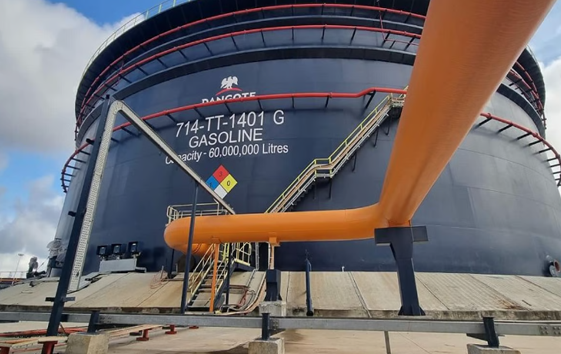



The regional fuel market centered in Offshore Lomé is currently facing significant disruption as the Dangote Petroleum Refinery aggressively cuts prices to N699 per litre.
This “price war” has squeezed the margins of international traders who traditionally used Togo’s waters as a ship-to-ship (STS) hub for supplying the West African sub-region.
A very well-supplied market in West Africa, coupled with a recent price cut at the Dangote refinery and an ongoing lack of Nigerian import permits, was dragging down flat prices and differentials in the gasoline market, according to sources and data from Platts, part of S&P Global Energy.
While Lomé prices typically fluctuate with global Brent crude swings, Dangote has adopted a fixed-price anchor (currently N699/litre for PMS). This fixed rate is often lower than the landing cost of imported fuel, making international arbitrage into Nigeria unprofitable.
According to S&P Global Commodities at Sea, in November and December, 1,800,000 mt of gasoline landed in West Africa, having originated from NWE. This was the largest volume registered on that route over a two-month period since November and December 2024.
Traders in Lomé have reportedly turned to heavily discounted Russian refined products to stay competitive. However, Dangote’s massive scale and proximity allow it to undercut these “sanctioned” cargoes, which face higher logistics and compliance costs.
With the refinery producing between 40 million and 50 million litres of PMS daily as of January 2026, the regional surplus is driving down “cracks” (the difference between crude and refined product prices), leaving traditional importers with thinning margins.
The Nigeria Import Permit Deadlock
A critical factor intensifying this pressure is the restriction of Nigerian import permits. Despite claims from the regulator (NMDPRA) that it has issued licenses for 7.5 billion litres for Q1 2026, local refiners and the government are pushing for “conditional licensing.”
Aliko Dangote, president of the Dangote Group and owner of the 650,000 barrels per day Dangote Refiney in Lagos, has publicly accused regulators of issuing permits to “frustrate” local refining. He argues that since his refinery can meet 100% of local demand, allowing imports is a “disservice” to the economy.
Marketers who previously relied on the “Lomé-to-Lagos” route are now finding their vessels stranded or unable to secure the necessary paperwork to discharge at Nigerian ports, as the government prioritizes the evacuation of Dangote’s massive 20-day national stock.
 Follow the MoneyCentral Nigeria channel on WhatsApp: Click here!