
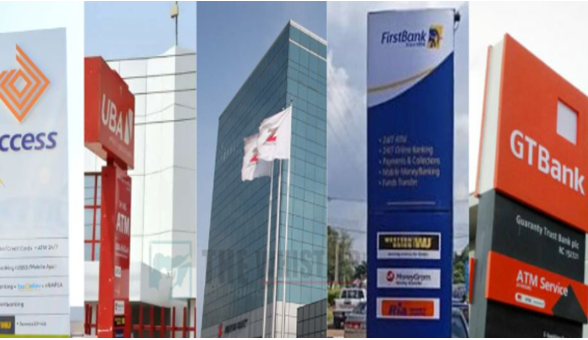



Nigeria’s top five banks expanded loan books by a meager average (4.6%) in the First Quarter (Q1) of 2026, signaling caution despite Central Bank of Nigeria (CBN) rate cuts that threaten income from securities.
Zenith Bank led with 13.25% quarter-on-quarter loan growth to ₦11.38 trillion, followed by First HoldCo (+5.26% to ₦9.43 trillion), Access Holdings (+1.42% to ₦13.53 trillion), UBA (+1.96% to ₦7.1 trillion) and GTCO (+1.24% to ₦3.17 trillion), according to MoneyCentral’s analysis of their Q1, 2026 financials.
Access Holdings continues to hold the largest loan book in the Nigerian banking industry at ₦13.53 trillion, reflecting its aggressive pan-African expansion and acquisition strategy.
Lending Appetite Varies
The Loan-to-Asset (LTA) ratio provides a clear window into a bank’s strategic priority. A low ratio suggests a “liquidity-first” approach, where resources are parked in government securities (Treasury Bills/Bonds), while a higher ratio indicates a focus on core lending.
Zenith Bank with a loan-to-asset ratio of 35.6% in Q1, 2026 and First HoldCo (35.1%) prioritize core lending, while Access came next at (25.3%) and UBA (21.6%).
Guaranty Trust Holding Company (GTCO) maintained the leanest loan book—among FUGAZ peers—relative to its size. With only 16.9% of its assets deployed as loans, the lender continues to prioritize high-efficiency, low-risk income from treasury instruments and electronic banking fees over traditional credit risk.
The gap between Zenith Bank (35.55%) and GTCO (16.9%) highlights two distinct philosophies: one betting on the recovery of the Nigerian borrower and the other banking on institutional liquidity and digital transaction volumes.
| Bank | Loan-to-Asset Ratio (Q1 2026) | Strategic Stance |
| Zenith Bank | 35.55% | Highest credit appetite among peers. |
| FirstHoldCo | 35.12% | Aggressively supporting real-sector growth. |
| Access Holdings | 25.32% | Moderate lending focus; heavy asset diversification. |
| UBA | 21.60% | Conservative credit posture. |
| GTCO | 16.90% | Least likely to extend credit; heavy treasury focus. |
Source: MoneyCentral Research, Company Financials
Market Outlook: The Squeeze on Interest Income
The cautious lending environment comes at a critical time for bank earnings. As the CBN begins to cut interest rates to stimulate the economy, the yields on government securities—where banks like GTCO and UBA have significant exposure—are expected to fall.
Banks with low LTA ratios may face “Net Interest Margin” (NIM) compression in late 2026 if they do not redeploy their idle liquidity into higher-yielding loans.
Growth Implications
Low credit extension is set to hamper economic transmission in Africa’s top oil producer. Zenith and First HoldCo’s aggression positions them for NIM resilience; while GTCO’s conservatism could be punished if yields continue to fall in 2026.
The loan-to-assets ratio is a key indicator of how much of a bank’s resources are deployed into its core activity, loans and credit creation, which are a vital source of economic growth.
 Follow the MoneyCentral Nigeria channel on WhatsApp: Click here!
 in the First Quarter (Q1) of 2026, signaling caution)