


Two of Nigeria’s most-watched energy stocks delivered blowout half-year numbers in the last week of July, but only one of them delivered clean shareholder value.
Seplat Energy Plc posted a 498% jump in net income and lifted its 2026 dividend target to a record 68.3 cents a share, while Aradel Holdings Plc reported revenue up nearly sevenfold to ₦2.49 trillion after consolidating its newly acquired stakes in ND Western Limited and the former Shell Petroleum Development Company joint venture.
Once non-controlling interest, finance costs and tax are stripped out, Aradel’s profit attributable to its own shareholders however grew just 6.3% — a fraction of its revenue growth — because nearly ₦37.4 billion of its ₦191.0 billion half-year profit now belongs to minority partners in the subsidiaries it just took control of.
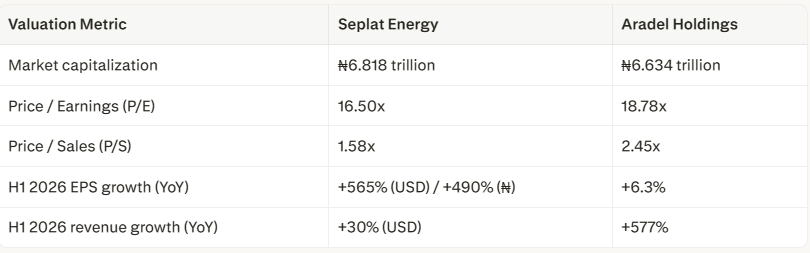
Seplat, by contrast, has almost no minority drag left, a fully quantified and growing dividend, and — at a P/E of 16.50x versus Aradel’s 18.78x — the cheaper valuation on both earnings and sales despite trading at a near-identical market capitalization of ₦6.818 trillion versus ₦6.634 trillion, data compiled by MoneyCentral shows.
Capital Structure and Minority Leakage Leaves Seplat Ahead on Dividends
The primary divergence in shareholder value creation stems from corporate ownership structures:
-
Aradel’s Minority Leakage: Aradel’s acquisition strategy—including increasing its stake in ND Western and acquiring equity in Renaissance Africa Energy—triggered consolidated top-line growth. However, because Aradel does not hold 100% of these operating subsidiaries, ₦37.38 billion of its ₦191.04 billion total net profit was claimed by minority equity holders. As a result, profit available to Aradel’s parent shareholders grew by just 6.32% year-on-year.
-
Seplat’s Direct Equity Flow: Seplat’s onshore and offshore operations flow directly to group equity holders. With no significant minority leakages, net earnings per share surged 565% to 26.6 U.S. cents, allowing the group to pass cash generation directly to shareholders via core and special dividend distributions.
Production and Other Business Lines
Both companies are diversified energy platforms rather than pure upstream plays, but they got there by very different routes — Seplat through operational execution across a legacy asset base, Aradel through a step-change acquisition that consolidated two previously part-owned entities.
Seplat’s growth is incremental and organic: an idle-well restoration programme, a ramping ANOH gas-condensate business, and a new 15-year, 200 MMscfd gas-supply agreement with UTM Offshore that will monetize up to 1.0 Tcf of gross gas resources from the Yoho field by 2030.
Aradel’s growth is structural and abrupt: the acquisition of an additional 40% of ND Western Limited for $300 million — turned two previously equity-accounted associates (ND Western/OML 34, and the former SPDC joint venture now branded Renaissance Africa Energy) into consolidated subsidiaries overnight, multiplying reported revenue and asset base.
Growth Prospects
SEPLAT: Seplat is guiding to 135–155 kboepd for full-year 2026, with capex of $360–440 million weighted to the second half.
Its offshore gas strategy is the clearest growth lever: the Oso-BRT pipeline upgrade is set to double gas supply to NLNG from 120 to 240 MMscfd by 4Q 2026, and the newly signed UTM Offshore gas-sales agreement anchors a Yoho-field FLNG project targeted for readiness by 2030.
Onshore, the idle-well restoration programme added 26 kbopd of gross JV production capacity from 24 wells in H1 2026 alone, and S&P upgraded Seplat’s credit rating to B+ in May 2026 on the back of falling leverage.
ARADEL: Aradel for its part is now digesting prior acquisitions. Having completed its landmark ND Western/Renaissance consolidation, management’s stated 2026 priority is “consolidating our expanded portfolio to enhance operational scale, improve efficiency across our assets, increase production and further diversify our revenue base.”
The upside case is real — Aradel now holds a 45% interest in OML 34 (through its 81.67% stake in ND Western) and a 53.3% effective interest in the former SPDC assets, giving it exposure to some of the Niger Delta’s largest reserve bases.
But the near-term financial picture shows the cost of that scale: finance costs rose to ₦326.1 billion from ₦11.1 billion a year earlier (up 2,843%), largely reflecting acquisition-related debt, while the effective tax rate jumped from roughly 23% to about 75% of pre-tax profit.
Non-Controlling Interest: The Silent Profit Drag
This is the sharpest divergence between the two companies, and it points in opposite directions.
Seplat’s minority interest has been falling as a share of profit as the core, wholly-owned business scales, while Aradel’s has exploded because roughly a fifth of every consolidated naira of profit — from OML 34 and the former SPDC assets — legally belongs to the minority partners in ND Western and Renaissance, not to Aradel Holdings’ own shareholders.
This is the main explanation for why Aradel’s 577% revenue growth and 30.5% total profit growth translated into just 6.3% earnings-per-share growth.
But for the ordinary shareholder measuring returns in earnings-per-share, the arithmetic is unambiguous: a large and growing slice of Aradel’s newly acquired profit pool is not theirs.
Seplat Wins on Valuation
Seplat and Aradel now sit within 3% of each other on market capitalization, but the market is asking Aradel investors to pay more per naira of earnings and per naira of sales.
While Aradel retains a strong net cash advantage and a dominant domestic refining and gas footprint, minority dilution and operational cost inflation have temporarily constrained its earnings per share growth.
Seplat, benefiting from dual LSE/NGX liquidity and hard-currency payouts, currently offers cleaner earnings translation and superior dividend visibility for income-focused equity investors.
Seplat is being priced more cheaply on both earnings and sales despite delivering earnings-per-share growth that outpaced net income growth — the opposite of dilution.
When measured strictly on the criteria that matter to a shareholder holding the stock today — dividends actually declared against current-period earnings, the share of profit that reaches ordinary shareholders after minority claims, and the price being asked for each naira of earnings and sales — Seplat Energy is the clearer value proposition.
Its dividend is growing and tied to current performance, on track for $410 million in 2026. Its minority-interest drag is shrinking, not growing. And it trades at a discount to Aradel on both P/E and P/S despite a market cap that is slightly larger.
Until Aradel’s NCI dilution stabilizes and its H1 2026 performance is reflected in a fresh dividend rather than a rollover of FY2025’s payout, Seplat remains the stock offering cleaner, cheaper, and more transparent shareholder value.
 Follow the MoneyCentral Nigeria channel on WhatsApp: Click here!