

A aggressive mix of equity capital raises and debt refinancing has thrown a lifeline to Nigeria’s largest consumer goods companies, fortifying balance sheets against further macroeconomic shocks.
According to calculations by MoneyCentral, the average debt-to-equity ratio for the sector’s most capitalized and liquid firms plummeted to 204.55% in the first half of 2026. This marks a massive recovery from the staggering 709.41% recorded in March 2025.
While the correction is historic, leverage remains elevated in absolute terms: consumer goods firms still owe an average of ₦2.69 to creditors for every ₦1 of shareholders’ equity. However, the trajectory is clearly pointing toward structural health, underscored by a 15.75% year-on-year drop in total cumulative debt (short- and long-term), which fell to ₦1.69 trillion down from ₦2 trillion in 2025.
Macro Winds Shift From Survival to Stability
The sector’s prior capitulation was driven by a painful cocktail of policy shifts: the central bank’s unification of foreign exchange windows and the Federal Government’s removal of fuel subsidies. The resulting hyperinflation and massive foreign currency revaluation losses gutted corporate margins.
The narrative for H1 2026, however, is one of hard-won recovery. Relative stability in the foreign exchange market alongside cooling inflationary pressures has allowed manufacturers to pivot. Receding borrowing costs and a sharp drop in exceptional, non-recurring losses are paving a clear path back toward sustainable earnings growth and bottom-line profitability.
“The outlook for the consumer goods sector remains positive for the second half of 2026. We expect revenue growth to remain supported by stable macroeconomic conditions, improving consumer demand, and continued investments in capacity expansion and product innovation,” said Meristem Securities analysts, in their 2026 Half Year Outlook Report.
“Profitability should also remain resilient as exchange rate stability, moderating inflation, and ongoing backward integration initiatives continue to improve operating efficiency and reduce input cost pressures. While elevated energy costs and competitive pricing may weigh on margins for select players, companies with strong brands, efficient distribution networks, and diversified product portfolios are well positioned to sustain earnings growth through the remainder of the year.”
The Sector Breakdown: Winners & High-Geared Outliers
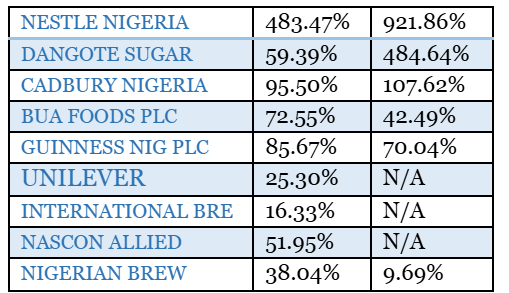
The pace of balance sheet rehabilitation varies widely across the market landscape, creating a distinct divergence between low-debt outperformers and heavily leveraged giants.
Consumer Goods Firms’ D/E Ratio vs ROAE
Corporate Strategy: Capital Markets Over Capex
In a notable tactical shift, corporate leadership across Lagos is aggressively prioritizing financial defensive maneuvers over physical expansion. Capital expenditure (CAPEX) has been sidelined in favor of balance sheet repair tools—most notably rights issues.
“Overall, the deleveraging cycle is expected to enhance earnings quality, improve cash flow conversion, and reduce sensitivity to both interest rate volatility and foreign exchange (FX) shocks, marking a transition from survival-driven financial management to more stability-focused corporate positioning in 2026,” analysts at Zedcrest Research noted.
 Follow the MoneyCentral Nigeria channel on WhatsApp: Click here!