
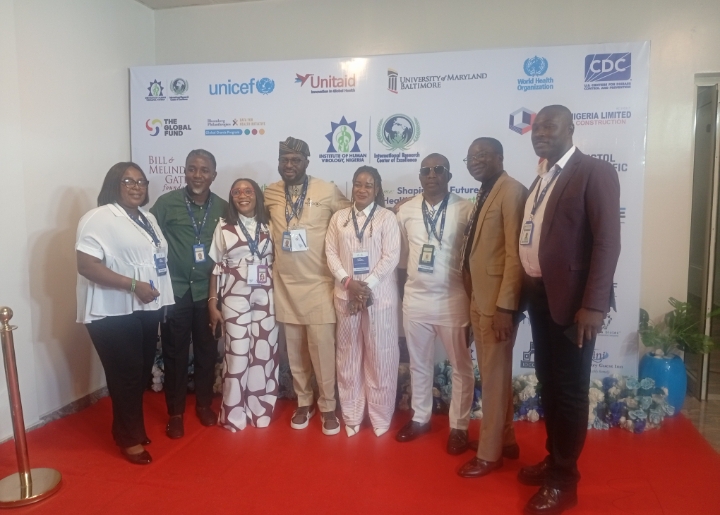



Medical experts and global health partners have advocated strategic integration of Artificial Intelligence (AI), machine learning (ML) and local capacity building to sustain public health research and data management in Nigeria.
The stakeholders made this known at the 4th Annual Scientific Symposium organised by the International Research Centre of Excellence (IRCE), Institute of Human Virology, Nigeria (IHVN), Monday in Abuja, with stakeholders examining innovation.
The two-day symposium was themed: “Shaping the Future of Public Health Research: Sustainable Funding, AI/ML & Innovation,” and focused on technology-driven solutions for sustainable scientific research and healthcare delivery across Africa.
Speaking via a recorded message, IHVN Chief Executive Officer, Dr Patrick Dakum, said data-driven innovation and technology were crucial to addressing emerging and future public health threats in Nigeria.
“This symposium will stimulate your minds, especially the young researchers, to think and carry out basic research, implementation research, and innovations related to AI and public health,” Dakum said.
He said the 22-year-old institute established IRCE after recognising that rigorous local research was vital to effective public health implementation and sustainable healthcare development across Nigeria and Africa.
Dakum, who referenced IRCE’s decade-long journey of excellence, said the Federal Government had introduced measures, including a sector-wide approach, to promote health system sustainability and strengthen healthcare delivery nationwide.
Prof. Alash’le Abimiku, Executive Director, IRCE, said dwindling international research funding necessitated adoption of advanced technologies to sustain scientific research, innovation and local solutions across Africa and Nigeria.
“Global research funding has been drastically truncated. As scientists, we must deploy AI tools to offset these resource gaps, ensure Africa remains in the global scientific race, and drive local discoveries forward,” she said.
She, however, cautioned that collected data quality must be strictly monitored to prevent unreliable information from compromising machine learning algorithms, research findings and public health decisions.
Corroborating her position, IHVN Managing Director, Dr Charles Mensah, said researchers did not need to wait for flawless or large-scale datasets before deploying AI tools effectively in research.
He said a rich but smaller dataset could initiate training, with AI models improving progressively as more data were generated, validated and incorporated from field activities and research programmes.
Mensah, however, said rigorous quality control and strict biosecurity measures were being deployed to prevent weaponisation, misuse or abuse of AI systems in research activities and applications.
Also speaking, Prof. Rose Anorlu, an expert in the Department of Obstetrics and Gynaecology, University of Lagos, called on researchers to break professional silos and strengthen inter-institutional collaboration.
Anorlu urged the Federal Government to eliminate political bottlenecks from scientific environments, saying this would enable domestic research to advance without unnecessary constraints and delays across institutions.
“We must work together rather than working in silos because when we work together, it makes things better.
“I hope the government of Nigeria will make progressive improvements in research so we do not put obstacles in our own way, moving two steps forward and ten steps backward,” she said.
Also, Dr Temitope Ilori, Director-General, National Agency for the Control of AIDS (NACA), said locally generated data remained the cornerstone of targeted health policies and interventions nationwide.
“With Artificial Intelligence for big data analysis, we can improve our public health systems, particularly in disease surveillance and ensuring targeted service delivery to the most vulnerable population,” she said.
Delivering a keynote address titled, “Engaging AI in Pandemic Preparedness: The Opportunities and Challenges for Africa,” Prof. Oyewale Tomori said public health systems could not operate independently of environmental realities.
Tomori, a foremost virologist and former President of the Nigerian Academy of Science, said climate change and environmental variability were altering the intensity and distribution of health risks across Africa.
He said weather and climate parameters, including temperature, rainfall and atmospheric pressure, directly affected transmission of infectious and respiratory diseases, making real-time modelling increasingly important for preparedness.
“Integrating meteorological datasets into public health research is critical to predict outbreaks before they degenerate into national emergencies,” he said.
Tomori said AI could maximise existing public health efforts by processing diverse environmental, educational and agricultural datasets concurrently to identify relationships and emerging health risks across populations.
He said AI could establish connections between different sectors and provide a stronger analytical framework for addressing complex public health challenges across Nigeria and Africa.
Tomori urged the Federal Government and scientific bodies to prioritise “capacity retention” rather than capacity building alone, emphasising that retaining local expertise was essential to achieving health security.
He said creating an enabling environment for local experts was essential to reducing reliance on international funding and strengthening Africa’s capacity to respond effectively to public health emergencies.
Concurring with Tomori, Abimiku said data gaps from historical outbreaks, including Lassa fever, often delayed effective responses and limited timely interventions during previous public health emergencies.
The representative emphasised the need to deploy real-time data modelling and AI to strengthen disease surveillance, improve outbreak prediction and support faster public health interventions nationwide.
Abimiku expressed delight at the growth of local scientific talent, saying IRCE was increasingly populated by exceptional young investigators contributing to Nigeria’s research ecosystem and scientific development.
She, however, said emerging scientists were highly proficient in handling AI tools, but a knowledge gap existed in translating technological solutions into responses to complex public health challenges.
She described the situation as an opportunity to establish robust mentorship pipelines by pairing experienced health researchers with tech-savvy young scientists to develop practical solutions together.
“During the hackathon session, I noticed that our young researchers thoroughly understood AI and all the software available, but had limited knowledge on how to apply them to public health challenges.
“It is an opportunity that effectively brings the young and the established researchers together to co-create solutions,” she said.
During a high-level panel session, health professionals raised concerns about data equity, fairness and power dynamics in global health data-sharing arrangements involving African countries and institutions.
Contributing online, Dr Etien Koua, Programme Area Manager for Health Emergency Intelligence and a senior representative of World Health Organization (WHO), urged African countries to build domestic digital capacity and strengthen bargaining positions.
Koua said fair governance, investment in capacity and equity were necessary to ensure data sharing benefited all parties and supported sustainable scientific development across African countries and institutions.
He said African countries had expressed concerns over existing data-sharing platforms, which were often used by secondary users without corresponding benefits accruing to host countries.
Koua said that WHO had established a technical working group to review data-sharing agreement contexts and genomic data parameters, promoting transparency and mutual benefit among participating countries.
Panellists also raised concerns over the low proportion of global data generated from Africa, noting that the gap challenged training robust AI models tailored to African populations.
They called on African governments to form united coalitions when entering bilateral agreements with foreign entities to prevent data exploitation and safeguard health sovereignty across the continent.
The symposium attracted support from local and international organisations, including APIN Public Health Initiatives, KNCV Nigeria and the International Science Council, which pledged collaborative efforts.
The organisations pledged to position Nigeria as a regional hub for advanced clinical and planetary health research while strengthening partnerships, innovation and local capacity development.

, machine learning (ML) and)