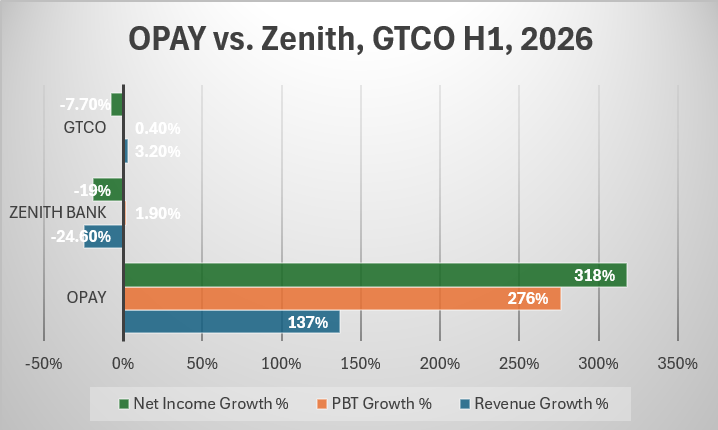



OPay Ltd. more than doubled its revenue and quadrupled its profit in the first half of 2026. Over the same period, two of Nigeria’s biggest lenders, Zenith Bank Plc and Guaranty Trust Holding Co., showed shrinking or stalled income.
The contrast suggests the fight for Nigeria’s mostly young, mobile-first customers is moving away from bank branches and into Apps.
OPay’s revenue rose 136.5% to $467.1 million, or about N623.8 billion, in the six months to June, according to the prospectus it filed with the SEC on October 9 for a New York Stock Exchange listing.
Pretax income rose 276% to $134.5 million (N179.6 billion), and net income jumped 318% to $90.9 million (N121.4 billion), while Nigeria contributed 89.5% of revenue.
MoneyCentral converted the figures at the official rate of N1,335.50 per dollar.
The banks however struggled to grow. Zenith Bank’s gross earnings fell 24.6% to N1.899 trillion. Pretax profit edged up 1.9% to N637.6 billion, while its June 2026 net income dropped 19% to N430.76 billion, mainly because of a higher tax bill.
Guaranty Trust Holding Company Plc (GTCO) posted an aggregate profit before tax (PBT) of ₦603.03 billion for its audited half-year period ended June 30, 2026. This represents a marginal year-on-year growth of 0.4% compared to the ₦600.9 billion recorded in H1 2025.
GTCO’s profit after tax fell 7.7% to N414.18 billion from N449 billion. Net fee and commission income dropped 9% to N123 billion. Loans to customers barely moved at N3.14 trillion, compared with N3.13 trillion in December, extending a pattern of weak credit growth at the lender.
Gross earnings rose 3.2% to about N1.1 trillion. A bigger revenue base however is no longer guaranteeing bigger returns for shareholders.
Where OPay Is Winning
While traditional Nigerian banks like Zenith and GTCO are still far larger, the concern for banks is speed and reach of OPAYs growth curve, not its current size.
OPay’s half-year revenue is about a third of Zenith’s gross earnings and 57% of GTCO’s, on MoneyCentral calculations. Its profit is roughly 28% of Zenith’s and 29% of GTCO’s.
OPay had 50.1 million monthly active users and 26.8 million daily active users on July 31, according to the Prospectus seen by MoneyCentral.
Monthly users have tripled since the first quarter of 2024. It processed 90.1 billion transactions worth $558 billion (about N745 trillion) in the 12 months to June. Gross transaction value, the total value of payments it processes, rose 143% to $339.1 billion in the first half.
Frost & Sullivan ranks OPay as the leading finance app in Africa and the Middle East, and the second most-used app of any kind in Nigeria by daily users. The prospectus says OPay accounted for about 66.1% of active users across Nigerian finance apps tracked by DataSparkle in the first half.
The company uses agents, 42 service centres and about 800,000 active point-of-sale terminals, apps built for cheap phones and weak networks, and accounts that can be opened in minutes.
That reaches the people banks have struggled to serve. Frost & Sullivan figures cited in the Prospectus filing show 44% of African adults have no bank account, against 21% globally. Africa also has five bank branches per 100,000 people, compared with 12 worldwide.
Lending and Deposits: The Real Threat
OPay is moving into the banks’ core business. New loans originated in Nigeria tripled to $927.6 million (N1.24 trillion) in the first half, and it had 6.7 million borrowers in the second quarter. That is more than seven times as many as in early 2024. Lending already makes up the largest share of its revenue: loan financing income rose 168% to $236.1 million.
It is also attracting savings. More than 42 million users have savings products, and balances reached $978.9 million (about N1.31 trillion) at the end of June. OPay says these deposits are interest-bearing and insured by the Nigeria Deposit Insurance Corp.
OPay’s loans typically last about 100 days, so the 204% rise measures new lending, not the size of the loan book. Its outstanding loans of $324.9 million (about N434 billion) equal roughly 3.6% of Zenith’s N12.05 trillion net loan book and 14% of GTCO’s.
Why the Banks Should Worry
The danger for banks is a slow loss of everyday customers rather than a sudden collapse. Fintech apps are becoming the default for Nigerians making payments and transfers, which is where fees are charged and deposit mobilization begins.
GTCO’s 9% fall in fee income comes as OPay’s transaction revenue rose 87% to $130.6 million. Once a customer’s salary, savings and small loans sit in one app, banks lose the cheap deposits and data that support their margins.
OPay’s prospectus describes traditional banks as having “high-cost, low-reach” branch networks and legacy technology, and says they focus on premium and large corporate clients.
Zenith’s own results show the banks are not standing still however. Zenith’s fee income rose 40% on digital transactions, and it widened its net interest margin to 12.4%. That suggests the larger lenders can compete if they invest in their digital channels.
OPay faces its own risks. Credit-loss provisions equalled 25% of revenue. It also says in the prospectus that regulators could cap its high loan rates. Limits on moving dollars out of Nigeria could also restrict dividends to foreign shareholders.
 Follow the MoneyCentral Nigeria channel on WhatsApp: Click here!