

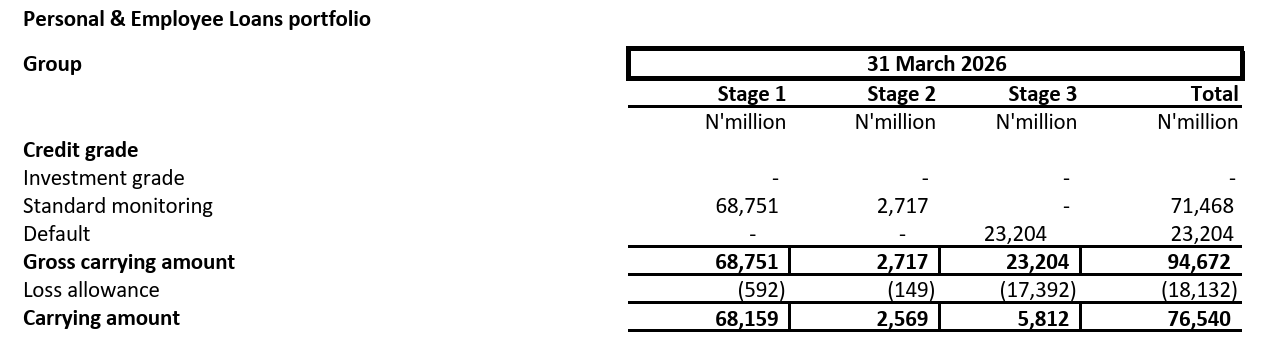
In an unsettling disclosure from its first-quarter 2026 financial notes, Fidelity Bank Plc revealed a massive ₦18.132 billion impairment allowance against its personal and employee loans portfolio at the Group level.
The significant write-down serves as a stark metric for the broader corporate and household landscape in Nigeria.
Because none of the tranches within this specific retail segment are currently classified as investment grade, the numbers highlight a severe, structural strain on the purchasing power and creditworthiness of the local consumer.
Key figures
| Metric | Amount (₦) |
|---|---|
| Loss allowance | 18.132 billion |
| Gross carrying amount of loans | 94.67 billion |
| Carrying amount after allowance | 76.54 billion |
| Loss allowance as % of exposure | 19.1% |
The 19.1% loss allowance represents nearly one-fifth of Fidelity Bank’s total loan exposure to personal and employee loans, well above typical impairment ratios for this category.
The gross carrying amount of the loans were ₦94.67 billion, while the carrying amount stood at ₦76.54 billion at the end of Q1, after the impact of the loss allowance.
Meanwhile, ₦23.2 billion of the loans were classified as Stage 3 loans or financial assets that are considered credit-impaired or in default.
Employee loan implications
Employee loans are supposed to be backed by salaries, making them traditionally lower-risk.
An impairment of this magnitude implies possible layoffs at firms where Fidelity Bank is exposed, as borrowers may lose income sources needed to service their debt. This could signal broader employment pressures in the corporate sector, particularly among mid-sized companies that typically access bank employee loan facilities.
The Layoff Indicator: A 19.1% loss allowance in a salary-backed book strongly implies that Fidelity is exposed to companies that have executed silent corporate downsizings, salary cuts, or outright suspensions. When a company lays off staff, the automated payroll links break, turning safe retail loans into uncollateralized bad debts overnight.
The retail loan stress aligns perfectly with Fidelity’s broader Q1 earnings framework, where overall credit loss expenses jumped by 364% to ₦29.20 billion.
The high loss allowance on personal loans reflects weakening consumer creditworthiness amid Nigeria’s cost-of-living crisis.
Higher transportation costs, food prices and energy bills continue to drain household budgets, making it harder for individuals to service unsecured personal loans.
Impact
The ₦18.1 billion impairment will directly pressure Fidelity Bank’s 2026 profitability, adding to the credit loss pressures the bank already faced earlier in the quarter.
Investors will monitor whether this impairment is a one-off provisioning catch-up or a indicator of ongoing stress. If consumer spending remains weak and employment pressures persist, Fidelity Bank may need to continue building provisions, which would further erode earnings.
The bank’s ability to manage credit costs while maintaining loan growth will be critical to its recovery trajectory after the 18.2% profit decline reported earlier this quarter.
The impairment also highlights the broader challenge facing Nigerian banks: as economic pressures mount, consumer and retail loan portfolios—often seen as higher-yielding—are becoming sources of significant credit risk that could offset gains from corporate and wholesale lending.
 Follow the MoneyCentral Nigeria channel on WhatsApp: Click here!