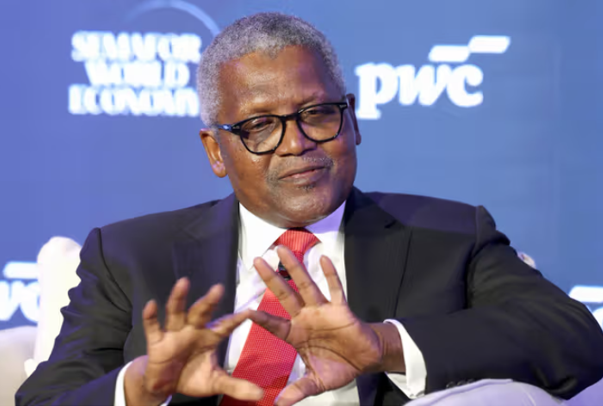



Billionaire Aliko Dangote’s industrial conglomerate has unveiled a massive $46 billion capital expenditure program aimed at doubling its petroleum refining capacity and locking down its dominance over sub-Saharan Africa’s energy landscape.
The three-year investment cycle, spanning 2026 to 2028, will bankroll an expansion of the group’s refining, cement, and fertilizer operations, according to Devakumar Edwin, Dangote Industries Limited’s Group Vice President of Oil and Gas.
The centerpiece of the strategy is an ambitious plan to scale total refining capacity to 2.1 million barrels per day (b/d). This includes boosting domestic output at the existing Lagos mega-refinery to 1.4 million b/d and constructing a brand-new 700,000 b/d refining complex in Kenya to serve the rapidly growing East African market.
The announcement came during a high-profile diplomatic visit by the Société Nationale des Pétroles du Congo (SNPC), the national oil company of the Republic of the Congo, which is seeking a long-term strategic partnership to secure refined petroleum products.
Redrawing the African Energy Map
Dangote’s multi-billion-dollar push into Kenya represents a major geopolitical and commercial shift. By placing a 700,000 b/d asset on the east coast of the continent, the group intends to eliminate East Africa’s reliance on fuel imported from Europe and the Middle East, replicating the disruptive import-substitution model it successfully deployed in Nigeria.
The downstream offensive comes at a critical time. In Nigeria, the 650,000 b/d facility has already begun altering local macro-fundamentals by upgrading regional fuel specifications to international eco-standards and easing the central bank’s foreign exchange burdens. Doubling down on this infrastructure infrastructure across two continental hubs positions Dangote as the de facto gatekeeper of African fuel security.
Sovereign Bilateral Crude-for-Fuel Deals
The visit by SNPC Managing Director Maixent Raoul Ominga underscores how Dangote is leveraging its massive processing scale to engage directly with sovereign oil producers. The Republic of the Congo, a net exporter of crude but a structurally deficient refiner of petroleum products, is looking to establish a bilateral loop: supplying raw crude to Dangote’s hooks while locking in guaranteed off-take agreements for gasoline, diesel, and aviation fuel.
“The Republic of the Congo has refining capacity, but we are keen to explore strategic cooperation that will help strengthen the supply of refined petroleum products,” Ominga told reporters, adding that the Lagos facility represents an unmatched industrial achievement for the continent.
Pre-IPO Valuation Fireworks
For international and domestic institutional asset managers currently stockpiling liquidity for the anticipated Dangote Petroleum Refinery initial public offering (IPO) on the Nigerian Exchange (NGX), this aggressive $46 billion roadmap alters the valuation calculus.
Rather than pitch the refinery as a mature, single-asset utility equity, Dangote is presenting investors with a high-growth, transnational energy conglomerate.
The inclusion of cross-border infrastructure plans, backed by relaxed institutional pension rules under PenCom waivers, is likely to further stoke institutional appetite, positioning the upcoming public offering as a highly competitive grab for African industrial equity.
 Follow the MoneyCentral Nigeria channel on WhatsApp: Click here!