

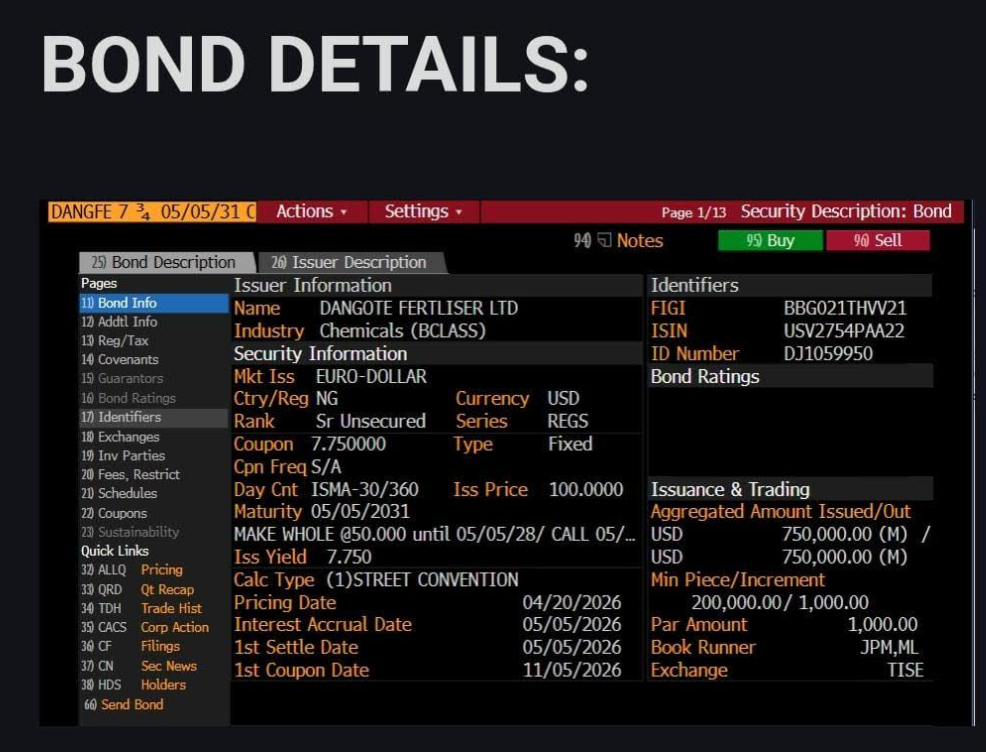
In a major test of international appetite for Nigerian corporate debt, Dangote Fertiliser Limited has successfully priced its debut $750 million 5-year Eurobond at a coupon rate of 7.75%.
This issuance issued as a Private Placement marks a critical step in the group’s refinancing strategy, specifically aimed at optimizing the debt profile of its massive industrial complex in the Lekki Free Zone.
The 7.75% pricing is being viewed by analysts as a “hard-earned win,” coming at a time when global yields have been volatile due to the Iran-Israel-U.S. conflict.
The rate sits competitively alongside Nigeria’s sovereign Eurobonds, such as the 7.875% 2032 Sovereign Eurobond, indicating strong investor faith in the “Big Green” export engine.
The Issuance includes a “Make Whole 50bps” call option until May 2028.
“Essentially, if Dangote wants to pay this debt off early because they’ve IPO’d and are swimming in cash, they have to pay the investors a premium to walk away,” an analyst told MoneyCentral.
JPMorgan, Merrill Lynch and Bank of America (BofAML) were the Bookrunner for the Eurobond which was issued on The International Stock Exchange (TISE).
Bond Details & Use of Proceeds
The proceeds from this Eurobond are likely earmarked for strategic debt restructuring and the initial phase of the group’s $40 billion expansion drive.
-
Debt Optimization: A significant portion of the $750m will be used to pay down expensive short-term intra-group loans and bridge financing used to scale the fertilizer plant to its current 3 million metric tonnes (MMTPA) capacity.
Global Appetite: Why Investors Bit at 7.75%
Despite the “War Premium” currently affecting emerging markets, Dangote Fertiliser’s business model provided a compelling “Naira-In, Dollar-Out” narrative.
-
Export Resilience: Unlike pure-play domestic firms, Dangote Fertiliser exports urea to markets in Brazil, the US, and across Africa, ensuring a steady stream of dollar revenues to service the interest.
-
The “Essential” Hedge: Fertilizers are a “defensive” asset. Even as global oil prices hit $110 on the back of the Iran conflict, the global demand for food security ensures that urea remains a high-value commodity.
-
Credit Rating Rebound: Investors were encouraged by the plant’s operational efficiency, which has helped offset Fitch rating constraints seen in late 2024 for the Dangote Group.
Market Context: Nigeria’s Re-entry into Global Debt
This issuance is a “bellwether” for other Nigerian corporates who may also be looking to tap the Eurobond market in 2026.
-
Sovereign Benchmark: The 7.75% rate is notably “tight” compared to recent African issuances. For context, Nigeria’s sovereign 9.248% 2049 Eurobond is currently yielding around 8.07% on the secondary market. Dangote’s ability to price below 8% suggests that high-quality corporate assets are currently viewed as safer than sovereign debt in some risk models.
-
The FTSE Catalyst: With Nigeria returning to the FTSE Russell Frontier Market Index in September, global funds are looking for high-quality corporate anchors. This Eurobond provides that exposure without the equity volatility of a direct stock purchase.
 Follow the MoneyCentral Nigeria channel on WhatsApp: Click here!