
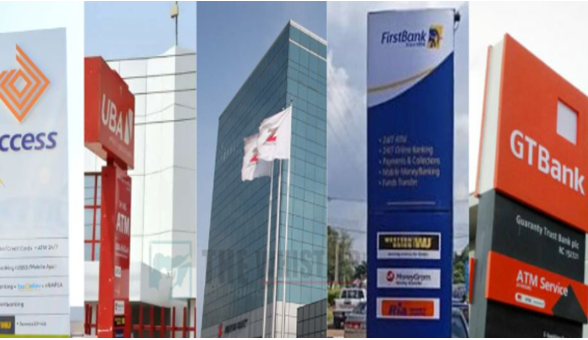



Wema Bank, Stanbic IBTC Holdings and FirstHoldCo delivered the highest return on average equity (ROAE) in Nigeria’s first-quarter bank results, highlighting where lenders are generating the most profit from shareholder capital.
Wema Bank topped the group with a return on average equity of 38.72%, closely followed by Stanbic IBTC at 38.57% and FirstHoldCo at 31.63%. Zenith Bank posted 26.14%, GTCO 24.80%, Access Holdings 19.86%, Sterling Bank 19.26% and UBA 13.70%, according to MoneyCentral’s analysis of the first quarter financial statements of the largest banks in Nigeria.
Capital Efficiency
Return on equity remains one of the clearest measures of banking performance because it shows how much profit a lender produces for each unit of shareholder funds. In a regulated industry where capital is constrained by buffers and supervisory limits, banks that sustain high ROE can create more value without needing proportionately larger balance sheets.
That puts Wema, Stanbic and FirstHoldCo ahead of peers in terms of capital efficiency, even in a difficult macroeconomic environment.
It also suggests those banks are better able to translate their equity base into earnings power.
FirstHoldCo Rebound
FirstHoldCo’s ROE marks a sharp recovery from the depressed 4.6% level recorded in December 2026 after balance-sheet cleanup efforts. The improvement supports investor confidence that the lender is entering a stronger earnings phase after the sanitation of its books.
By contrast, the lower ROEs among the remaining lenders suggest weaker value creation per naira of equity, which can weigh on stock market ratings over time. Persistent underperformance on this metric often makes bank shares less attractive to foreign investors and can increase the cost of raising capital.
Market Read-Through
The numbers reinforce a broader pattern in Nigeria’s banking sector: profits remain healthy, but the quality of those profits differs widely by lender. Those with stronger ROE profiles are better placed to defend valuations, especially as foreign exchange conditions stabilize and reforms continue to support credit quality.
At the same time, inflation-adjusted returns remain far lower than the nominal figures suggest, which helps explain why foreign investors still demand a larger risk premium for Nigerian bank stocks.
Q1 2026 Return on Average Equity (ROAE) Rankings
Wema Bank outpaced the entire banking industry in capital efficiency, capitalizing on its lean structure and high-velocity digital deposits to maximize shareholder returns.
| Rank | Bank / Holding Company | Q1 2026 ROAE (%) | Valuation Context (Market Pricing) |
| 1 | Wema Bank Plc | 38.72% | Trading at historical premium |
| 2 | Stanbic IBTC Holdings | 38.57% | Premium multiple (~2.22x Price-to-Book) |
| 3 | FirstHoldCo Plc | 31.63% | Rapid turnaround asset post-balance sheet clean-up |
| 4 | Zenith Bank Plc | 26.14% | Moderate premium (~1.1x exit target multiple) |
| 5 | Guaranty Trust Holding (GTCO) | 24.80% | High-liquidity defensive hold with 16.9% loan-to-asset ratio |
| 6 | Access Holdings | 19.86% | Deep discount (~0.34x Price-to-Book) |
| 7 | Sterling Financial Holdings | 19.26% | Undergoing retail and digital banking transition |
| 8 | United Bank for Africa (UBA) | 13.70% | Deep discount (~0.47x Price-to-Book) |
Source: MoneyCentral, Company Financials
Strategic Drivers: Deep Dive into the Top Three
The outperformance of the top three institutions highlights a successful departure from standard treasury-dependent banking models:
-
Wema Bank’s Digital Arbitrage (38.72%): Wema’s pole position is driven by its ALAT retail platform. By avoiding the massive cost overhead of heavy brick-and-mortar branch setups, the bank captured high-velocity transactional retail float during a period of intense fintech competition. This allowed them to efficiently pass on returns without straining their capital buffers.
-
Stanbic IBTC’s Wealth Model (38.57%): Stanbic avoids the heavy credit drag of traditional lenders by combining its banking lines with Nigeria’s largest asset management and pension fund business. This capital-light, fee-driven model generates non-interest revenue (NIR) that goes straight to the bottom line without expanding risk-weighted assets.
-
FirstHoldCo’s Dramatic Turnaround (31.63%): FirstHoldCo recorded a dramatic recovery in ROAE from the depressed 4.6% seen at the end of its balance sheet sanitation phase. After aggressively purging legacy non-performing loans (NPLs) and kitchen-sinking bad credit, the group successfully redeployed cleaned equity into the real sector, growing its loan book by 5.26% in Q1 alone.
 Follow the MoneyCentral Nigeria channel on WhatsApp: Click here!
 in Nigeria’s first-quarter bank results)