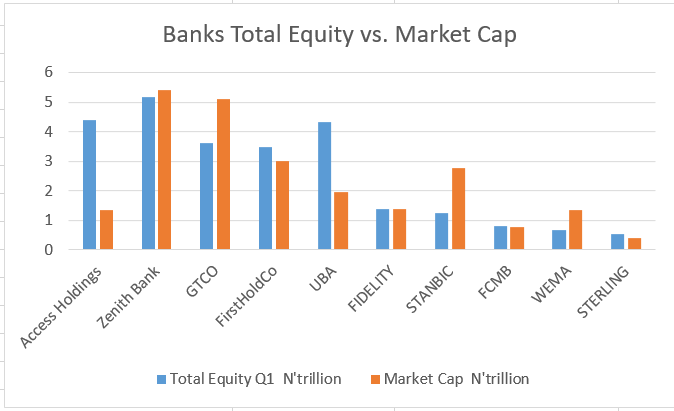



Nigerian banking stocks have a potential ₦6 trillion upside rally as the majority trade at deep discounts to shareholder equity, with Access Holdings and United Bank for Africa (UBA) offering the most compelling re-rating opportunities, according to MoneyCentral calculations.
Data from the first quarter of 2026 shows that Nigeria’s top-tier banking index is sitting on a massive valuation gap.
While the broader NGX All-Share Index has returned 60.49% year-to-date, several of the country’s largest institutions—boasting parts of a ₦202 trillion combined asset base—are trading at sharp discounts to their standalone shareholder equity.
The P/B Disconnect: Discounted vs. Premium Lenders
Led by Access Holdings and United Bank for Africa (UBA), a majority of Nigerian lenders are priced well below their net asset values (NAV).
If the market triggers a traditional mean-reversal trade to value these stocks at a baseline Price-to-Book (P/B) ratio of 1.0x, the resulting re-rating could trigger an unprecedented ₦6 trillion market capitalization expansion.
Top upside opportunities
| Bank | Shareholder Equity (₦) | Market Cap (₦) | P/B Ratio | Upside to 1x Book (₦) |
|---|---|---|---|---|
| Access Holdings | 4.396 trillion | 1.338 trillion | 0.30x | 3.058 trillion |
| UBA | 4.310 trillion | 1.951 trillion | 0.45x | 2.359 trillion |
| FirstHoldCo | 3.471 trillion | 3.000 trillion | 0.86x | 471 billion |
| Sterling Bank | 542 billion | 411 billion | 0.76x | 131 billion |
| FCMB | 823 billion | 775 billion | 0.94x | 48 billion |
| Fidelity Bank | 1.386 trillion | 1.365 trillion | 0.99x | 21 billion |
Source: MoneyCentral (Q1 2026 Bank financials)
Shareholder equity represents the net value of a company—total assets minus total liabilities.
For banks, this is the theoretical amount remaining for common shareholders if the bank were liquidated and creditors paid. Banks trading below book value (P/B ratio under 1.0x) means their stock price is lower than net asset value per share, highlighting a market valuation discount to balance sheet equity.
Access Holdings trades at just 0.3x book value while UBA sits at 0.45x, meaning investors are paying 30% and 45% respectively of the institutions’ stated equity value. This condition often signals a potentially undervalued “bargain,” though it also reflects investor skepticism about asset quality, earnings sustainability, or macro risks.
The Premium Players (Trading Above Book Value)
These institutions have successfully convinced the market to price them on capital efficiency and high-velocity digital earnings rather than pure asset accumulation.
-
Stanbic IBTC Holdings (2.20x P/B): Commands the industry’s highest premium by running a capital-light, wealth-management-driven model that avoids heavy credit risks.
-
Wema Bank (1.97x P/B): Powered by its ALAT ecosystem, Wema outpaced the industry with a 38.72% return on equity, turning digital scale into a premium market multiple.
-
Guaranty Trust Holding (1.41x P/B): Highly favored for its defensive stance, keeping over 35% of its balance sheet in liquid central bank cash placements.
-
Zenith Bank (1.05x P/B): Validated by its position as Nigeria’s most profitable lender, bringing in ₦360.91 billion in Q1 PBT following its core technology overhauls.
Banks trading above book value
| Bank | P/B Ratio |
|---|---|
| Stanbic IBTC Holdings | 2.20x |
| Wema Bank | 1.97x |
| GTCO | 1.41x |
| Zenith Bank | 1.05x |
Source: MoneyCentral
The Upside: The Access and UBA Anomalies
The fact that Access Holdings and UBA are valued at just 0.30x and 0.45x of their book value highlights a massive gap between internal balance sheet strength and stock market pricing.
-
Access Holdings’ ₦3 Trillion Gap: Access anchors the entire financial ecosystem with a massive ₦53.43 trillion total asset base. Despite generating high interest income by parking ₦16.81 trillion in high-yield government securities, its market value sits at just ₦1.338 trillion. This deep discount means investors are essentially getting the bank’s massive corporate infrastructure and international footprint for less than a third of its liquid net worth.
-
UBA’s Pan-African Cushion: UBA maintains a formidable ₦4.31 trillion equity base, backed by structural, pan-African dollar cash flows across 20 countries. While its Q1 earnings dipped 21% due to currency stabilization and high subsidiary overhead, its core trade finance business remains highly profitable. At 0.45x book value, the market has overly penalized its short-term earnings volatility, ignoring its long-term role as a regional trade gateway.
MoneyCentral expects a Mean Reversal and Macro Re-Rating
The coexistence of banks trading well above book value (Stanbic IBTC at 2.2x, Wema at 1.97x) alongside deep discounts at Access and UBA creates a classic mean-reversion trade opportunity.
If market sentiment improves and valuation discounts narrow, the ₦6 trillion gap to 1x book value could unlock significant shareholder value. Access Holdings alone accounts for over half the upside potential at ₦3.058 trillion, followed by UBA at ₦2.359 trillion.
This ₦6 trillion valuation gap is unlikely to remain open indefinitely. Two major market events are converging to trigger a multi-billion-dollar rotation into banking equities:
-
The September FTSE Russell Reclassification: This September, FTSE Russell will officially restore Nigerian equities to Frontier Market status. This reclassification will trigger automated, systematic buy orders from global index-tracking funds. Faced with strict mandates to deploy capital, these global managers will naturally target the most liquid, deeply discounted large-cap stocks on the exchange—making Access, UBA, and FirstHoldCo primary targets for foreign inflows.
-
The Big-Ticket Syndication Boom: Nigeria’s real sector is undergoing an unprecedented capital deployment phase. With Dangote Group announcing a landmark $4 billion financing agreement to accelerate its expansion into the fuel and petrochemical sectors, led by Access Bank and Afrexim, the demand for elite corporate trade finance is soaring. Only institutions with multi-trillion-naira equity bases like Access and UBA can comfortably anchor and syndicate these mega-deals, translating industrial scale straight into non-interest fee income.
Outlook
Investors will monitor asset quality trends, provisioning levels, and macroeconomic conditions including interest rates and currency stability. However, the rerating will accelerate if global funds return to Nigeria following the expected FTSE Russell frontier-to-emerging market reclassification, which would increase demand for large-cap, liquid banking stocks.
 Follow the MoneyCentral Nigeria channel on WhatsApp: Click here!