

As the Nigerian Exchange heads into the final full trading week of the first half of 2026, a sharp divergence has emerged within its elite tier: 18 out of the 30 components of the benchmark NGX-30 Index are underperforming the broader market.
The lopsided rally has left the majority of Nigeria’s largest corporate titans trailing the benchmark NGX All-Share Index (ASI), which has surged an impressive 51.62% year-to-date (YTD). Because the NGX-30 represents more than 90% of the market’s total capitalization, this wide performance gap signals that a small cluster of hyper-performing stocks is skewing the main index higher, leaving substantial liquid assets ripe for a mean-reversal play.
Institutional investors and local fund managers are quietly preparing for capital rotation as the second half of the year approaches, hunting for deep value among the laggards.
Aradel, WAPCO Lead Top Heavy Elite
The NGX-ASI is up 51.62% year-to-date (FRI, June 19th), driven by a narrow set of high-beta winners.
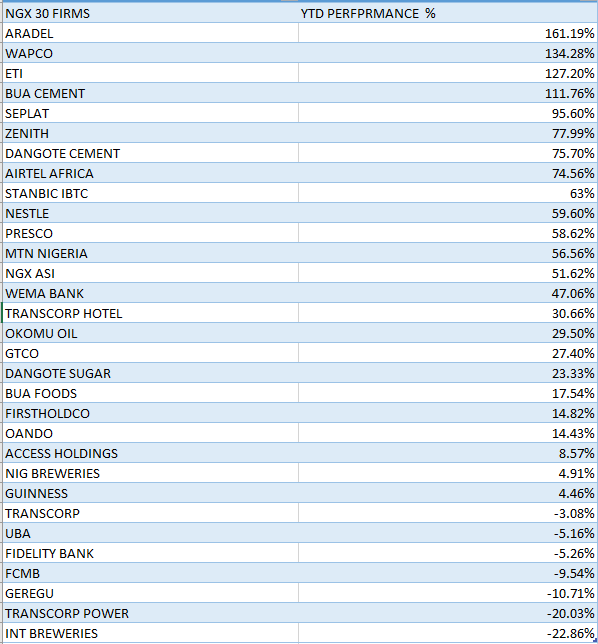
Top outperformers versus the NGX-ASI include Aradel Holdings, which has surged 161.19%, Lafarge WAPCO at 134.28%, Ecobank Transnational at 127.2%, BUA Cement at 111.76%, Seplat Energy at 95.6%, Zenith Bank at 77.99%, Dangote Cement at 75.7%, Airtel Africa at 74.56%, Stanbic IBTC at 63%, Nestlé at 59.6%, Presco at 58.62%, and MTN Nigeria at 56.56%, according to data compiled by MoneyCentral.
The Mean Reversal Thesis
For asset managers evaluating portfolios ahead of Q3, the concentration of gains in the aforementioned heavyweights presents a clear structural risk—and a contrarian opportunity.
Historically, when the broader index is pulled upward by a narrow group of momentum stocks, the market eventually undergoes an allocation reset. Underperforming equities that boast solid fundamentals but have suffered from low sentiment typically experience a “mean reversal,” where capital flows out of overstretched gainers and back into underpriced laggards.
The list of underperformers includes highly profitable institutions currently trading at deep discounts to their historical multiples. For instance, top-tier financial holding companies GTCO (+27.4%) and Access Holdings (+8.57%) have failed to keep pace with the ASI despite solid liquidity profiles. Consumer goods powerhouse BUA Foods (+17.54%) has similarly lagged, while international Breweries (-22.86%) and tier-two Fidelity Bank (-5.26%) slipped into negative territory for the year.
Banking and consumer-goods names dominate the underperforming list, suggesting a sectoral tilt in the outperformance.
NGX-30 Year-to-Date Performance vs. NGX-ASI
What to Watch in H2
Investors are likely to watch whether the underperformers can attract fresh inflows as half-year rebalancing flows set in, and whether earnings momentum, dividend yields, or improved macro conditions—such as a softer policy rate or stable FX—provide the catalyst for a rotation.
The upcoming mid-year financial filings will also likely serve as the primary catalyst for this shift. If corporate earnings for lagging financial institutions and consumer goods firms come in strong, it will reveal a stark fundamental mismatch against their depressed share prices.
The NGX-30’s dominance of market cap means any broad rotation into the underperformers could lift the broader index, while failure to rotate would keep the market reliant on the same handful of high-flyers.
The Bottom Line: The first half of 2026 was defined by chasing top-tier momentum. However, with 18 of the top 30 stocks lagging behind, the smart money heading into July is betting on a structural rotation. Value-driven investors are likely to start lock-stepping out of overextended energy and industrial counters to capture the inevitable pricing corrections waiting among the underperforming blue chips.
 Follow the MoneyCentral Nigeria channel on WhatsApp: Click here!