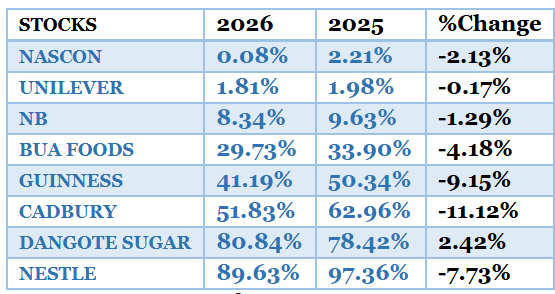



Nigerian consumer-goods companies are facing a sharper solvency spotlight as two laggards—Nestlé Nigeria Plc and Dangote Sugar Plc—report debt-to-capital ratios far above the sector average, according to MoneyCentral calculations.
Nestlé Nigeria’s debt-to-capital ratio sits at 89.63%, while Dangote Sugar measures 80.84%, compared with an industry average of 37.93%. The metric, which shows how much of a company’s capital structure is funded by borrowed versus owned funds, signals heavy leverage that can amplify profits in good times but heightens insolvency risk when performance falters.
“High leverage isn’t an immediate alarm if earnings cover interest comfortably,” said a senior credit analyst at a Lagos-based investment bank. “But in a high-rate, inflationary environment, borrowing costs can balloon quickly and erode that cushion.”
The Central Bank of Nigeria held its benchmark Monetary Policy Rate at 26.5% during the 305th MPC meeting, while the 10-year government bond yield stood at 16.79% on June 18. Headline inflation rose to 15.93% in May, the third consecutive monthly increase and the highest since November 2025.
Dangote Sugar’s debt stack is especially complex. The company has N200 billion of publicly issued bonds at coupons between 11.85% and 23.5% with maturities of three to 10 years. It also issued N119 billion of commercial paper maturing in 180 to 265 days at discounts of 16% to 17%.
The firm owes N66.68 billion in bulk-commodity loans to related party The Bulk Commodities International, denominated in USD at 6% to 8.5%. Bank loans totalling N248.49 billion, including letters of credit for inventories and fixed assets, carry an average rate of SOFR plus 8%.
The maturities and pricing mix create a layered risk profile. Short-dated commercial paper requires frequent rollover in a tight funding market, while bond coupons up to 23.5% and floating SOFR-linked bank loans expose the company to US-rate moves and naira volatility. USD debt adds another layer of risk if the naira weakens further.
For investors, the focus should be on interest coverage—EBIT or EBITDA divided by interest expense—cash-flow stability, and the debt maturity schedule over the next 12 to 24 months. Analysts also watch liquidity buffers, including cash on hand and undrawn credit lines, and any covenant breaches or amendments that could signal stress.
Lower debt-to-capital ratios below 40% typically indicate a conservative capital structure and better resilience in downturns. Ratios above 60% suggest a company is heavily leveraged. While Dangote Sugar and Nestlé Nigeria currently generate enough earnings to cover interest, the macro backdrop—high policy rates, rising inflation, and elevated bond yields—could pressure borrowing costs and credit metrics.
The risk is not immediate failure but a higher probability of financial trouble if rates rise further or if demand softens. In that scenario, the heavy debt load on these two firms could become a tangible solvency concern faster than for peers with more equity-funded capital structures.
 Follow the MoneyCentral Nigeria channel on WhatsApp: Click here!