

Nigerian real estate has firmly established its positioning as a premier defensive asset class, attracting heavy institutional capital from fund managers seeking reliable inflationary hedges and predictable hard-currency cash flows.
Historical performance sheets demonstrate that local rental rates consistently track in line with, or even outpace, domestic price indexes. This indexing mechanism is most visible within the commercial office, logistics industrial, and premium residential segments, where leases are either directly structured in U.S. dollars or explicitly linked to USD parallel market benchmarks.
This structural design offers international and high-net-worth allocators a continuous, organic currency hedge that completely insulates corporate yields from domestic Naira fluctuations.
Targeting the Mid-Market Vacuum
While premium commercial builds provide a high-end currency refuge, the deepest operational alpha is increasingly concentrated within the mass retail residential space.
Strategic development desks are shifting their machinery away from luxury real estate to focus aggressively on the mid-market and affordable housing corridors.
Because the structural deficit for middle-income and entry-level homeownership across metropolitan hubs like Lagos and Abuja remains deep and largely unaddressed, developers targeting these defensive niches are benefiting from exceptionally fast market absorption rates and highly resilient occupancy levels that insulate them from broader consumer spending squeezes.
The Institutional Mutual Fund Revolution
The sector is concurrently undergoing a major financial metamorphosis. Institutional asset managers are rapidly abandoning the legacy speculative private equity (PE) model—where fund success was entirely dependent on a volatile, high-stakes liquidation sale at the tail-end of a multi-year investment cycle—in favor of continuous, yield-generating income funds and real estate investment trusts (REITs).
This structural shift exploded into the mainstream following the high-profile launch of the Ministry of Finance Incorporated Real Estate Investment Fund (MREIF).
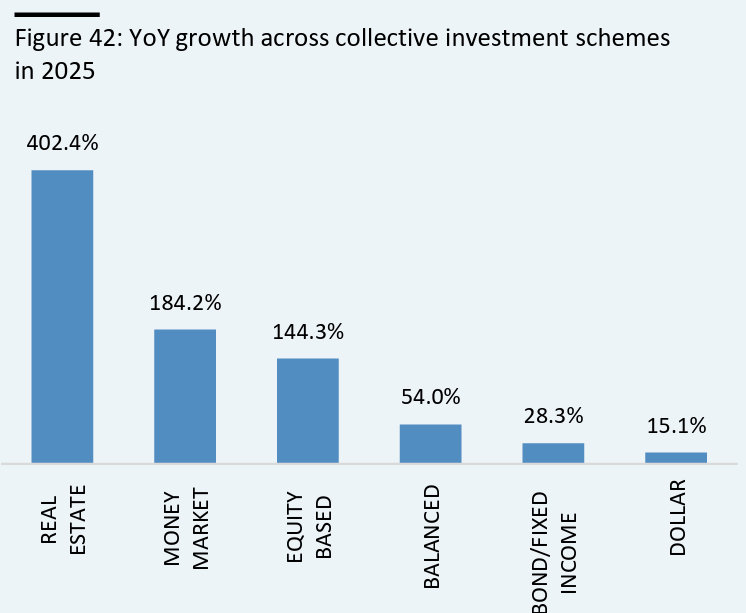
The entry of the specialized mega-fund acted as a primary liquidity catalyst, driving a spectacular 5.0x year-over-year surge in the aggregate Net Asset Value (NAV) of real estate mutual funds to hit ₦501.2 billion.
Compounding at an impressive five-year CAGR of 63.8%, the real estate collective investment segment has easily outperformed all other local asset management pools, confirming that both retail and corporate balance sheets are eager to buy into managed brick-and-mortar vehicles to secure long-term capital preservation.
 Follow the MoneyCentral Nigeria channel on WhatsApp: Click here!