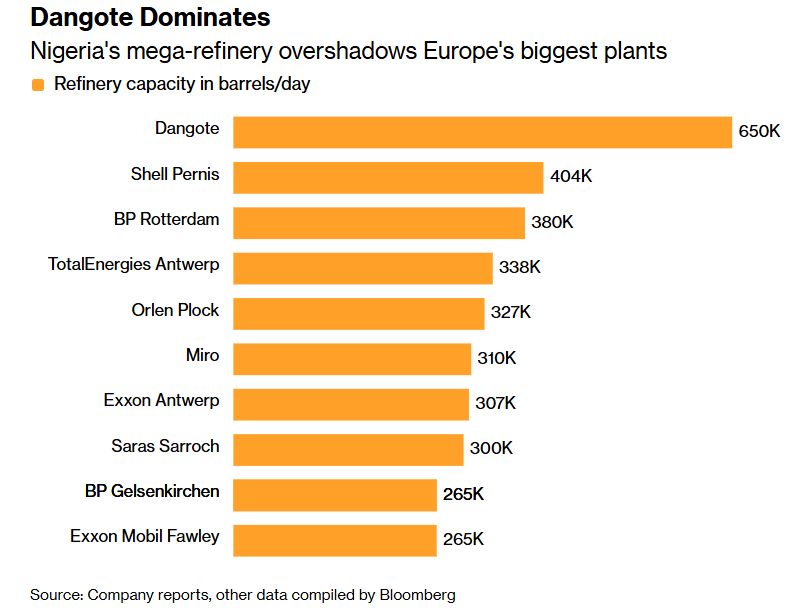



The Dangote Petroleum Refinery has rapidly transitioned from a regional energy solution to a critical pillar of European aviation security.
As the U.S.-Israel-Iran conflict paralyzes traditional supply routes from the Persian Gulf, the 650,000 bpd facility in Lekki has surged its exports of Jet A1 fuel to Europe to unprecedented levels.
Dangote’s jet fuel shipments to Europe hit a record of about 50,000 barrels a day in March, and more shipments are enroute, according to the Kpler data, which includes kerosene from which jet fuel is made.
This development marks a historic reversal of trade flows: Nigeria, once the primary “dumping ground” for European refined products, is now the essential supplier helping the continent avoid a total aviation fuel crisis as prices there hit all-time highs.
The 650,000 barrel-a-day facility, one of the world’s biggest, has raised its jet fuel shipments to Europe to unprecedented levels with prices in the continent recently hitting the highest on record.
The refinery is “highly profitable,” said Alan Gelder, senior vice president of refining, chemicals and oil markets at consultancy Wood Mackenzie. He assessed the facility’s gross margin was over $30 a barrel based on crude and product pricing for early April, compared with about $15 for refineries in Europe.
“It has advantages in both crude and product pricing, and product yields,” he said.
A spokesman for the refinery said that gross margin assessment wasn’t entirely accurate, but declined to provide more data. He said that they are seeing demand for jet fuel from Europe, adding that the plant’s overall exports of the product including to other locations is the equivalent of about 110,300 barrels a day in April compared with just shy of 116,000 a day last month.
Running at full capacity and meeting local requirements, the refinery is able to export its products “competitively in any market” because of the “low unit cost of production,” the spokesman said.
Full Capacity
The plant cranked up to capacity in mid-February when its single crude unit — which makes it the biggest one-train refinery in the world — reached 100% operating rate and the residue fluid catalytic cracker unit restarted after planned maintenance, according to the company.
Average crude inflows over the first quarter equated to 460,000 barrels a day, according to tanker-tracking data compiled by Bloomberg.
Almost 70% of that was made up of local Nigeria supply, according to the data, helping the company save on soaring war-induced freight costs. The remainder mainly came from the US.
Africa Swing Supplier
The refinery’s operations also mark a turnaround for Nigeria, which previously sent its crude to refineries in Europe and bought expensive products in return. The country became a net exporter of gasoline in March when Dangote shipped 44,000 barrels a day, versus no exports of the fuel in the previous two months, the refinery said in a statement, citing Kpler data.
The refinery’s operations also mark a turnaround for Nigeria, which previously sent its crude to refineries in Europe and bought expensive products in return. The country became a net exporter of gasoline in March when Dangote shipped 44,000 barrels a day, versus no exports of the fuel in the previous two months, the refinery said in a statement, citing Kpler data.
Supplies are increasingly headed to African nations that depend on imports from the Middle East. One 317,000-barrel cargo was recently sent to Mozambique, marking Dangote’s first gasoline exports to the east of the continent. Another is expected this month.
The refinery has exported a total of about 79,500 barrels a day of diesel this month compared with about 73,600 a day in March, according to the company. Gasoline shipments are 50,100 barrels a day from nearly 102,400 a day last month.
 Follow the MoneyCentral Nigeria channel on WhatsApp: Click here!