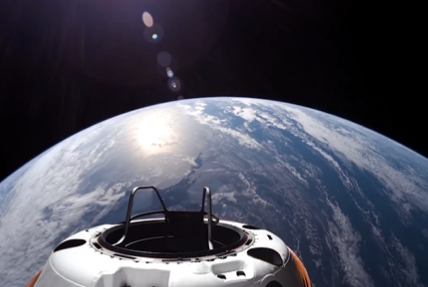



An all-commercial group of four civilian space astronauts aboard the SpaceX Dragon Capsule via the Polaris Dawn mission has just achieved a significant milestone.
“Polaris Dawn and Dragon at 1,400 km above Earth – the farthest humans have traveled since the Apollo program over 50 years ago,” Elon Musk’s space company wrote on X early Wednesday morning.
Polaris Dawn and Dragon at 1,400 km above Earth – the farthest humans have traveled since the Apollo program over 50 years ago pic.twitter.com/rRDeD1dY1e
— SpaceX (@SpaceX) September 11, 2024
Musk quoted SpaceX’s post by saying, “Strive to greater heights, For a future brighter than the past, Waking up each morning inspired, To learn new secrets of the Universe!”
Polaris Dawn on X provided a mission update:
The Polaris Dawn crew completed their first day on-orbit, also known as Flight Day 1. After a successful launch by SpaceX’s Falcon 9 rocket to low-Earth orbit from Launch Complex 39A at NASA’s Kennedy Space Center in Florida at 5:23 a.m. ET, the crew took off their spacesuits and began their multi-day mission.
Shortly after liftoff, the crew began a two-day pre-breathe protocol in preparation for their anticipated spacewalk on Thursday, September 12 (Flight Day 3). During this time, Dragon’s pressure slowly lowers while oxygen levels inside the cabin increase, helping purge nitrogen from the crew’s bloodstreams. This will help lower the risk of decompression sickness (DCS) during all spacewalk operations.
About two hours into Flight Day 1, the crew enjoyed their first on-orbit meals before engaging in the mission’s first science and research block and testing Starlink, which lasted about 3.5 hours.
About two hours into Flight Dragon made its first pass through the South Atlantic Anomaly (SAA), a region where Earth’s magnetic field is weaker, allowing more high-energy particles from space to penetrate closer to Earth. Mission control operators and the crew worked closely to monitor and respond to the vehicle’s systems across all high-apogee phases of flight, particularly through the SAA region.ay 1, the crew enjoyed their first on-orbit meals before engaging in the mission’s first science and research block and testing Starlink, which lasted about 3.5 hours.
Mid-day, the crew settled in for their first sleep period in space, during which Dragon will perform its first apogee raising burn. Orbiting Earth higher than any humans in over 50 years, the crew will rest for about eight hours ahead of a busy day on Flight Day 2.
Most excitingly, during its first orbit, Dragon reached an apogee of approximately 1,216 kilometers, making Polaris Dawn the highest Dragon mission flown to date. Following a healthy systems checkout, the crew and mission control will monitor the spacecraft ahead of the vehicle raising itself to an elliptical orbit of 190 x 1,400 kilometers at the start of Flight Day 2.
Orbiting Earth on board Dragon, the Polaris Dawn crew talked with families of @FoldsofHonor, an organization providing educational scholarships to spouses and children of America's fallen and disabled military service-members and first responders 🇺🇸 pic.twitter.com/1lY7Tz2ssd
— Polaris (@PolarisProgram) September 11, 2024
 Follow the MoneyCentral Nigeria channel on WhatsApp: Click here!