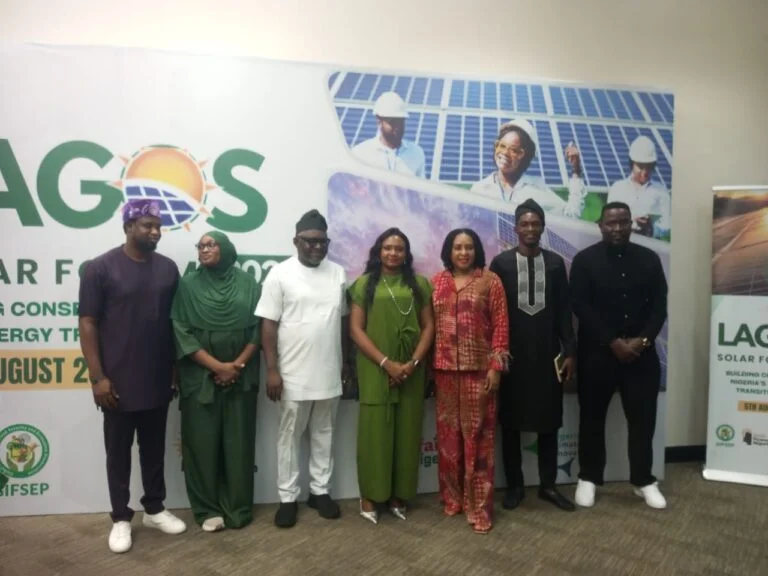



Mr Olamide Fagbuji, Senior Special Assistant to the President on Climate Technology, says the Federal Government is committed to accelerating Nigeria’s energy transition.
Fagbuji said this on Wednesday at the Lagos Solar Forum 2026, a high-level policy dialogue convened under the Solar Power Nigeria Coalition in Lagos.
The News Agency of Nigeria (NAN) reports that the forum had as its theme, “Building Consensus for Nigeria’s Just Energy Transition Future.”
He called for collective action among stakeholders to expand energy access, promote industrialisation, create sustainable jobs, strengthen food security and build a resilient, low-carbon economy.
Fagbuji said achieving a just energy transition required strong collaboration among government, private sector, academia, civil society, development partners and the diplomatic community.
“Nigeria’s energy transition represents both an environmental necessity and a significant economic opportunity.
“Improving energy access through solar and renewable energy is central to achieving sustainable development, strengthening industrial competitiveness, creating jobs and enhancing national energy security,” he said.
He said climate change had become a major economic, social and security challenge, citing increasing climate-induced disasters globally and locally as evidence of the urgent need for resilient energy systems.
He stressed that climate resilience and energy resilience were inseparable, adding that Nigeria must take advantage of the global shift towards clean energy.
Fagbuji noted that global investments in clean energy now exceed those in fossil fuels, stressing the need for Nigeria to position itself to benefit from the transition.
He acknowledged Nigeria’s persistent energy access challenges, noting that millions of households and businesses still relied on expensive diesel generators and traditional cooking fuels.
According to him, the situation constrained productivity, increased business costs and adversely affected public health.
He, however, said Nigeria’s abundant solar resources provided a strategic advantage that could support universal energy access and drive economic transformation.
Fagbuji commended the Federal Government’s policy reforms, particularly the Electricity Act 2023, describing it as landmark legislation that decentralised electricity generation and distribution.
He said the reforms provided the legal foundation for accelerating renewable energy deployment and attracting private investment.
He urged stakeholders to position renewable energy as an industrial strategy capable of driving local manufacturing, technology transfer, export opportunities and job creation.
Fagbuji said Nigeria should avoid relying solely on imported renewable energy technologies while developing domestic capacity to participate meaningfully in the emerging clean-energy economy.
Also speaking, Mr Chris Kiff, Senior Director of the Secure Energy Project, underscored the importance of collaboration and coordination in advancing Nigeria’s renewable energy transition.
He said numerous organisations, institutions, development partners, private sector actors and civil society groups were implementing valuable initiatives across the energy sector.
Kiff, however, said many of the efforts operated independently, limiting their collective impact.
He said the objective of the dialogue was not to launch another campaign or establish a new standalone initiative.
“Rather, the meeting seeks to provide a platform where stakeholders can identify existing efforts, share experiences and explore opportunities for greater coordination under a common framework,” he said.
Kiff urged participants to align diverse initiatives under a unified platform that would strengthen collaboration, minimise duplication and maximise collective impact.
He also stressed the need to build stronger networks across the renewable energy ecosystem to enable stakeholders to understand one another’s work.
According to him, stronger networks would help stakeholders identify areas for partnership and develop shared solutions to common challenges.
In his presentation, Founder of AfriEnergy Tracker, Mr Daniel Awolaja, examined investment trends, electricity access challenges, policy developments and opportunities for accelerating Nigeria’s energy transition.
Awolaja said Nigeria had an installed electricity generation capacity of about 14 gigawatts, but only about five gigawatts were consistently delivered through the national grid.
According to him, nearly 90 million Nigerians still lacked reliable access to electricity, highlighting the persistent gap between installed capacity and actual power supply.
He said 2025 marked a particularly strong year for Nigeria’s energy sector, with about three gigawatts of new electricity generation capacity added.
Awolaja, however, noted that increased installed capacity had yet to translate into reliable electricity access, as electricity demand continued to outstrip available supply.
He said the situation had resulted in widespread dependence on petrol and diesel generators.
In his opening remarks, Dr Michael Terungwa, Executive Director of the Global Initiative for Food Security and Ecosystem Preservation, said energy poverty continued to undermine economic growth and human development.
According to Terungwa, energy poverty was trapping many communities in poverty.
“Nigeria has one of the largest electricity access deficits in the world.
“In spite of being one of Africa’s largest economies, Nigeria’s national electricity grid remains one of the least reliable on the continent, with electricity demand consistently exceeding supply.
“According to the World Bank’s 2025 report, about 86.8 million Nigerians lack access to electricity, the highest number globally.
“Millions of Nigerians rely on generators, while the removal of fuel subsidy has further worsened the situation.
“The good news is that many Nigerians are now turning to solar energy as a lifeline.
“Solar energy offers Nigeria a real opportunity to bridge its energy gap by providing clean, affordable and accessible electricity to millions left behind by the national grid,” he said.