
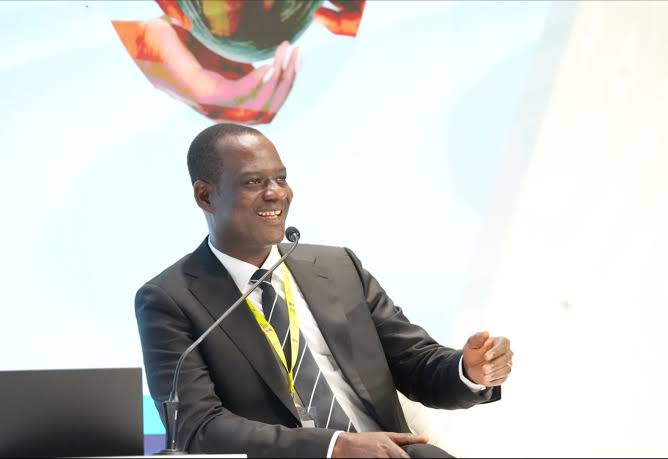



Mr Taiwo Oyedele, Chairman, Intergovernmental Group of Twenty-Four (G-24) says macroeconomic stability, inclusive growth and deliberate policies are essential to creating jobs and improving living standards in developing countries.
Oyedele said this while fielding questions at a news briefing by the G-24 at the 2026 IMF/World Bank Meetings in Bangkok on Tuesday.
He said economic stability and job creation were not mutually exclusive, stressing that a stable macroeconomic environment provided the foundation for sustainable growth and prosperity.
“Stability itself is the foundation upon which you can build the growth and prosperity that you want for your people,” he said.
Oyedele also highlighted the potential impact of artificial intelligence (AI) on employment, particularly in developing countries with large youth populations.
He said the adoption and regulation of AI required deliberate planning to ensure that technological advancement and economic growth did not lead to increased unemployment.
He said achieving such objectives was a collective responsibility that required coordinated efforts by governments, international financial institutions and other stakeholders.
“What that means is that it is not only just the World Bank and the IMF.
“ This is a collective responsibility for all of us to ensure that growth is not just for the sake of growth. It has to be inclusive, and must be able to translate to better living standards for our people,” he said.
On the balance between taxation and borrowing, Oyedele said governments needed to carefully weigh the implications of both options.
He said that excessive taxation could disproportionately affect vulnerable households by reducing their ability to afford food, healthcare and education, while borrowing could create future repayment obligations.
He said the ultimate objective of taxation and borrowing should be to improve citizens’ welfare.
“If you put people always at the centre of your policies, you will not be perfect, but you are likely to strike a balance that works and is sustainable,” he said.
On climate finance, Oyedele called for collective action to ensure that African countries received adequate support to pursue development without being forced to increase carbon emissions.
He said that fairness required developed countries to support developing economies, particularly Africa, given the continent’s relatively small contribution to global carbon emissions.
According to him, climate action should not undermine economic development or worsen poverty in developing countries.
“We do not want a clean world with hungry people. So this balance again requires collective action from all of us,” he said.
Oyedele said international cooperation remained essential to ensuring that climate policies supported sustainable development without imposing undue constraints on poorer countries.
Also, Dr Iyabo Marsha, Director and Head of the G24 Secretariat, said macroeconomic stability was an important foundation for growth and development.
Marsha said that countries without stable macroeconomic environments would struggle to implement structural reforms, employment policies and infrastructure development programmes.
She said the emphasis placed on macroeconomic stability by the IMF and economists globally should complement other policies designed to stimulate growth and create jobs.
The News Agency of Nigeria(NAN) reports that the G-24 is a coalition of developing and emerging-market countries established to coordinate the position of developing countries on monetary and development issues.
G-24 Member Countries include Algeria, Argentina, Brazil, Colombia, Côte d’Ivoire, Democratic Republic of Congo, Ecuador, Egypt, Ethiopia, Gabon, Ghana, Guatemala, Haiti, India, Iran, Kenya, Lebanon, Mexico, Morocco and Nigeria.
Others are Pakistan, Peru, Philippines, South Africa, Sri Lanka, Syria, Trinidad and Tobago, Venezuela, and China as a special invitee.
 Follow the MoneyCentral Nigeria channel on WhatsApp: Click here!
 says macroeconomic stability, inclusive growth and deliberate policies are essential to creating jobs and improving living standards in developing countries.)