



…OPay’s Growth Sharpens Questions Over Access Capital Allocation as Valuation Lags
Access Holdings Plc’s expansion across Africa and beyond is facing question marks from investors as the lender’s asset growth and cross-border ambitions have yet to translate into a valuation comparable with faster-growing digital-finance rivals such as OPay Ltd.
Access Bank Chief Executive Officer Roosevelt Ogbonna said in July 2024 that the group had invested about $1.2 billion in its African and international banking subsidiaries.
The spending was part of a broader strategy to build a continent-wide bank, with the lender targeting trade, payments and corporate-banking flows across African markets and beyond.
Access rapid push abroad, led to the snapping up of assets from Standard Chartered Plc, Atlas Mara Ltd., and KCB Group Plc, among others, to counter naira weakness and non-performing loans.
The question now is whether the investment has spread Access too thin just as fintechs have intensified their hold on Nigeria’s mass-market payments, transfers, merchant acquisition and consumer-finance businesses.
“We are chasing the money,” Ogbonna said during Access Holdings’ rights-issue presentation at the Nigerian Exchange in 2024, describing southern and eastern Africa as more profitable banking markets than parts of West Africa.
He said Access had shifted from an investment phase into a period of consolidation after years of acquisitions, expansion and technology spending.
Scale vs. Market Value
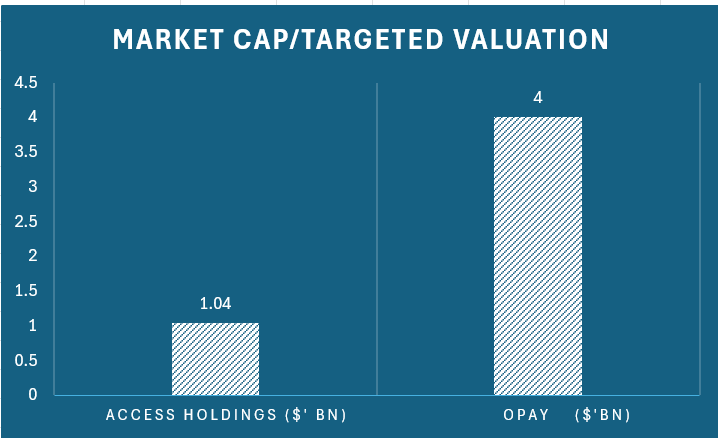
Access remains Nigeria’s largest bank by assets, but the market is placing a far lower value on the group than on OPay’s prospective $4 billion IPO valuation.
At ₦1.46 trillion, Access’s market capitalization is roughly one-quarter of OPay’s proposed valuation.
That disparity does not make the two businesses directly comparable. Banks carry far larger balance sheets, tighter regulation, credit risk and capital requirements, while fintech valuations are often driven by growth expectations, customer acquisition and payment volumes.
Still, the contrast reinforces investor concern that Access’s rapid asset expansion has not yet produced sufficiently strong returns on shareholder capital. Moreover OPAY is just 8 years old in Nigeria and its growth has coincided with the period that Access went chasing the elusive Golden goose overseas.
OPay’s Growth Spurt
OPay reported 2025 revenue of $536.25 million, up 161% from a year earlier, and net income of $72.47 million (₦101.45 billion) compared with a $50.98 million loss in 2024, according to the latest figures seen by MoneyCentral ahead of its IPO. Opay’s 2025 profit was larger than that of Sterling Bank which reported Profit after tax of ₦76.3 billion in 2025.
Gross transaction value rose 115% to $358 billion, lending increased 285% to $938.3 million, and monthly active users grew 57% to 39.3 million.
The numbers highlight how fintech platforms are monetizing the retail market through high-frequency transactions, merchant payments, wallet balances, credit and digital distribution.
For Access, which acquired Diamond Bank in 2019 in a transaction that significantly expanded its Nigerian retail footprint, OPay’s scale raises questions about whether the group is extracting enough value from its domestic customer base.
Access has argued that its strategy is not centered only on Nigeria. Ogbonna said the lender had built a presence in 15 African countries, alongside operations in the UK, France and the UAE, and was pursuing a globally connected African banking platform. He said the bank had about 60 million customers, making it one of Africa’s largest retail banking franchises by customer count.
Access Returns Under Pressure
Access Holdings reported full-year 2025 profit after tax of ₦743 billion, a 15.6% increase from ₦642 billion a year earlier. Interest income rose 5.4% to ₦3.27 trillion, while net fee income gained 40.9% to ₦585 billion.
The headline profit growth masked balance-sheet pressure. Loan impairment charges increased 209% to ₦287.3 billion, while impairment on other financial assets climbed 463% to ₦258.8 billion. Total comprehensive income fell to ₦459 billion from ₦1.01 trillion, weighed down by a ₦272 billion foreign-currency translation loss and a ₦137 billion fair-value loss on debt securities.
Access’s 0.37-times book-value valuation is the clearest market signal of investor caution. Such a discount can reflect concern about future earnings quality, rising credit costs, capital demands, exposure to foreign-currency volatility and uncertainty over whether overseas expansion will deliver returns above the group’s cost of equity.
Capital Allocation Debate
Aigboje Aig-Imoukhuede, Access Holdings’ chairman, told investors during the 2024 rights-issue event that companies eventually need to consolidate and “sweat the assets” they have built. That challenge has become more urgent as the group balances regulatory capital needs with shareholder demands for better returns.
Access’s expansion has increased its geographic reach, diversification and potential access to higher-growth African markets. But it has also required substantial capital, added regulatory complexity and exposed the group to currency translation effects, varying credit cycles and execution risks across multiple jurisdictions.
It has also led to delays in filing quarterly financial results leading to the inability of investors to get a timely snapshot of its operations and leading to a sense of opacity and lack of clarity about its earnings outlook.
The central issue is not whether Access should have built an African or international platform, as its cross-border franchise provides strategic value in trade finance, remittances, corporate banking and regional payments.
The issue is whether the group can now convert scale into stronger returns on assets and equity, while defending Nigeria’s retail-banking franchise against digitally native competitors.
Opay as the New Bride as old Banking Assumptions Fall Apart
Opay has become the new banking bride as investors including established banks seek a piece of the fast growing fintech ahead of its IPO.
Standard Bank Group Ltd., Africa’s largest lender by assets and parent company of Stanbic IBTC Holdings Plc, is in early-stage negotiations to acquire a equity stake in Nigeria-focused digital payments platform OPay Digital Services Ltd.
The strategic transaction comes as OPay prepares for a New York initial public offering (IPO) that could value the fintech firm at $4.0 billion—double the $2.0 billion valuation achieved during its Series C funding round in 2021.
OPay has retained Citigroup Inc., Deutsche Bank AG, and JPMorgan Chase & Co. as lead underwriters for the planned US listing.
Nigerian lenders like Access Bank and Guaranty Trust Holding Company (GTCO) pushed to transform into a Holding Company (HoldCo) model thinking that growth will come from varied non-bank subsidiaries such as Pensions, Asset management and Payments.
So far the lesson has however been that core retail banking and using technology to crack consumer lending like the fintech’s (Opay, Moniepoint) have done has been far more of a growth driver.
What Investors Will Watch
The next phase for Access is less about acquiring new assets and more about proving it can extract higher returns from the ones it already controls. OPay’s rapid move from loss to profitability shows the value investors place on scalable retail payments and digital distribution.
For Access, the challenge is to turn its larger customer base, banking license, deposit franchise and regional network into a similarly compelling shareholder proposition.
 Follow the MoneyCentral Nigeria channel on WhatsApp: Click here!