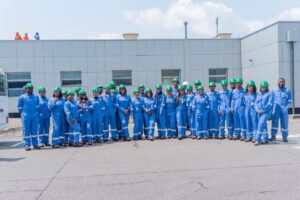



Thirty-five young professionals in Nigeria’s oil and gas industry have received practical training in gas production and export operations during a visit to Nigeria LNG Ltd., Bonny Island, Rivers.
The visit was organised under the Decade of Gas Capability Building Programme, which aims to develop more than 150 professionals by 2030 to support Nigeria’s ambition of becoming a gas-powered economy.
Mr Ed Ubong, the Coordinating Director, Decade of Gas Secretariat, disclosed this in a statement made available to newsmen on Tuesday in Lagos.
Ubong, who led the delegation, said that the participants inspected NLNG’s operational Trains 1 to 6 and the ongoing Train 7 expansion project.
He said that the programme combined technical instruction with practical exposure to industrial-scale gas operations to equip participants with the skills and experience needed to contribute to the development of the sector.
“What we are building is not just knowledge, but confidence and competence,” he said.
Ubong said that firsthand exposure to gas operations was essential to preparing young professionals for the country’s gas development ambitions.
“You cannot drive a gas-powered economy from theory alone.
“Our young professionals must see, touch and understand how gas is processed, liquefied, stored and exported to the world,” he said.
He described NLNG as a major example of Nigeria’s achievements in the gas industry, adding that the visit exposed participants to international operational standards.
According to him, the programme targets more than 150 professionals, including engineers, geoscientists, commercial analysts and policymakers, by 2030.
He said that the beneficiaries would support gas-based industrialisation, power generation, increased LPG penetration, CNG adoption and gas-to-chemicals projects.
Ubong said that the Decade of Gas Programme identifies natural gas as a key driver of Nigeria’s energy transition, economic diversification and industrial development.
He added that capacity building is one of its seven strategic pillars, with the Secretariat planning further practical engagements with regulators, upstream operators and gas infrastructure companies.
The Managing Director of NLNG, Mr Adeleye Falade, who received the delegation alongside members of the company’s management team, said that human capital development was critical to building a sustainable gas industry.
“At NLNG, we believe that gas is not just a commodity. It is a platform for national transformation. And transformation is driven by people,” he said.
Falade said that NLNG’s operations and ongoing Train 7 expansion demonstrated Nigeria’s capacity to develop and sustain major gas infrastructure.
He urged the participants to uphold high standards of safety, sustainability and local content in their professional careers.
He said that their decisions over the next decade would influence Nigeria’s ability to harness its more than 200 trillion cubic feet of gas reserves for power generation, industrial development, job creation and national prosperity.
The visit featured technical sessions on LNG production, plant integrity, health, safety and environment, as well as shipping and export logistics.
Participants also interacted with NLNG engineers and managers on the company’s operations and expansion plans.
A female participant, who spoke on behalf of the delegation, said that the experience had broadened her understanding of the LNG value chain.
She said that the opportunity to observe the operational facilities and Train 7 expansion project provided valuable insights into the processes supporting Nigeria’s LNG exports.
 Follow the MoneyCentral Nigeria channel on WhatsApp: Click here!