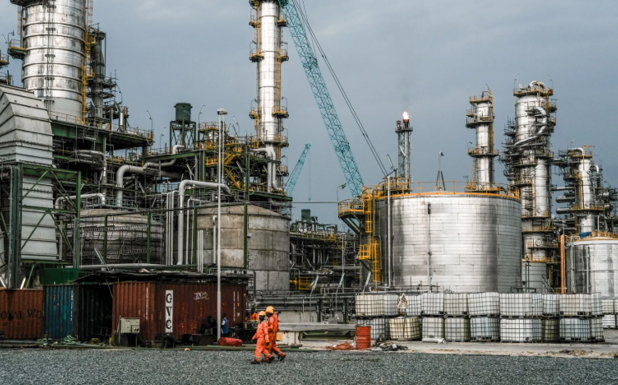



Nigeria’s fuel trade has undergone a dramatic reversal since the arrival of the Dangote refinery, with petroleum product exports surging more than seven-fold while seaborne imports have fallen to less than a third of their 2023 level.
Nigeria exported an average of 350,000 barrels of petroleum products per day in the second quarter of 2026, up from an annual average of just 46,000 barrels per day in 2023, according to new data published by the U.S. Energy Information Administration (EIA).
At the same time, Nigeria’s seaborne petroleum product imports fell below 130,000 barrels per day, compared with nearly 400,000 barrels per day three years earlier.
The figures provide one of the clearest indications yet of how the Dangote Petroleum Refinery is changing a long-standing contradiction in Africa’s oil industry, where one of the continent’s major crude producers depended heavily on imported refined fuel.
Exports to Europe reached an average of 130,000 barrels per day in the second quarter, nearly nine times the 15,000 barrels per day shipped to the continent in 2023.
Nigeria also exported nearly 120,000 barrels per day to other African countries during the quarter, up from 89,000 barrels per day in 2025.
The EIA attributed much of the change to the Dangote refinery, which began operations in 2024.
Before the facility entered production, Nigeria’s existing state-owned refineries shipped less than 100,000 barrels per day of petroleum products by sea, both domestically and internationally.
Total seaborne petroleum product shipments from Nigeria, which include exports and shipments between Nigerian ports, averaged 561,000 barrels per day in the second quarter of 2026.
That compares with just 79,000 barrels per day in 2023.
The refinery’s growing output has allowed Nigeria to simultaneously reduce imported products, supply more fuel domestically and build an export business serving markets in Africa and Europe.
Domestic seaborne shipments reached 211,000 barrels per day in the second quarter, compared with 81,000 barrels per day in 2025 and only 33,000 barrels per day in 2023.
The EIA’s analysis is based on shipping data from energy and freight analytics company Vortexa.
A global supply disruption accelerated the shift
Dangote’s rise in international fuel markets has also coincided with disruption elsewhere.
The refinery completed maintenance and an expansion in February 2026 that increased its crude distillation capacity from 650,000 barrels per day to 700,000 barrels per day.
That expansion came as petroleum product supplies through the Strait of Hormuz were constrained, creating an opening for alternative suppliers.
The timing gave Nigeria additional room to supply markets traditionally served by refiners elsewhere.
Earlier this year, Dangote petrol cargoes were shipped to several African markets, including Ghana, Côte d’Ivoire, Cameroon, Togo and Tanzania, as disruptions in the Middle East tightened supplies.
The refinery’s geographical position on Africa’s Atlantic coast also gives it access to both regional markets and major international shipping routes.
The numbers are beginning to show up in Nigeria’s external accounts
Nigeria’s Central Bank said Dangote exported $5.85 billion worth of refined petroleum products in 2025, helping support the country’s goods trade surplus.
Nigeria’s refined petroleum product imports, meanwhile, declined by almost 29% to $10 billion in 2025 from $14.06 billion a year earlier.
The same CBN data, however, exposes another side of the transition.
Dangote imported $3.74 billion worth of crude oil in 2025, despite operating in one of Africa’s biggest oil-producing countries.
The refinery has at different points turned to foreign crude, including supplies from the United States, as it sought sufficient feedstock for its operations.
That means Nigeria’s refining transformation has not eliminated its exposure to international energy markets. Instead, the nature of that exposure is changing, from importing large quantities of finished petroleum products towards importing some crude that can be processed domestically and sold at home or abroad.
Nigeria is becoming a bigger supplier to both Africa and Europe
Europe has emerged as one of the biggest beneficiaries of the increase.
Nigeria’s petroleum product exports to Europe rose from 15,000 barrels per day in 2023 to 40,000 barrels per day in 2025 before reaching 130,000 barrels per day in the second quarter of this year.
Exports to other African countries also climbed to nearly 120,000 barrels per day.
The figures strengthen Dangote’s potential role as a regional refinery rather than one built solely to meet Nigerian demand.
That ambition could become considerably larger. Dangote Group plans to add another 750,000-barrel-per-day crude distillation unit by 2028, according to the EIA.
If completed as planned, the expansion would significantly increase the amount of crude the complex can process and potentially deepen Nigeria’s role in international refined petroleum markets.
For decades, Nigeria exported crude oil while spending billions of dollars bringing petrol, diesel and other refined products back into the country.
Three years of shipping data now show that equation beginning to move in the opposite direction.