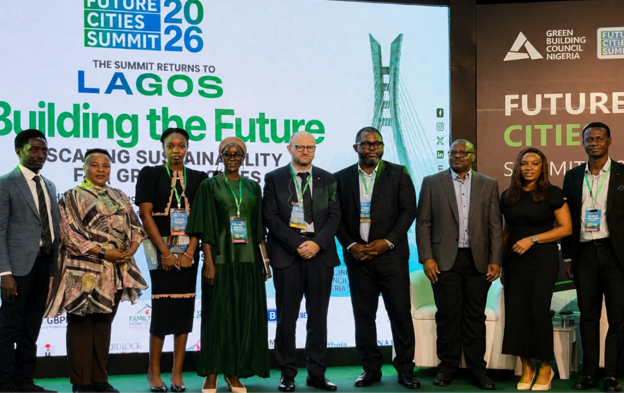



Julius Berger Nigeria Plc has reaffirmed its commitment to sustainable urban development and environmentally responsible construction through its participation in the Future Cities Summit 2026, organized by the Green Building Council Nigeria (GBCN) in Lagos.
Held under the theme, Building the Future: Scaling Sustainability for Greener Cities, the summit brought together leading stakeholders from across the built environment sector to explore innovative and practical solutions for advancing sustainable construction, enhancing urban resilience, and accelerating the transition to greener cities.
On the second and final day of the summit, Julius Berger’s Regional Manager, Engr. Thomas Christl, participated as a panellist in the plenary session titled “Materials, Methods, and Margins: Low Carbon Construction Constraints and Opportunities.” Also representing the company at the event was Chief Risk Officer, Mrs. Shakira Mustapha.
The panel featured prominent industry experts, including General Manager, Saint-Gobain Nigeria; Mr. Tope Ilusanmi, Sustainable Finance Consultant, Alitheia Capital; Miss Ruby Uche, and Sustainability and Green Building Consultant, Enflor, Ariyike Maama Adeshina, who served as moderator.
Speaking during the session, Engr. Christl identified the high upfront investment required for low-carbon construction as one of the major barriers to wider adoption. However, he emphasized that sustainable buildings provide significant long-term value through reduced maintenance costs, improved operational efficiency, and lower energy consumption.
“Sustainable construction should be viewed from a lifecycle perspective,” Christl stated even as he added, “while initial investments may be higher, the long-term economic and environmental benefits far outweigh the costs, delivering value for owners, occupants, and society as a whole.
Highlighting practical pathways to reducing the industry’s carbon footprint, Engr. Christl underscored the importance of recycled concrete as a viable and sustainable construction material. According to him, the reuse of concrete from demolished structures can substantially reduce carbon emissions while minimizing dependence on newly manufactured materials.
He further called for stronger collaboration among academic institutions, construction companies, material manufacturers, and regulators to establish clear standards and regulatory frameworks that support the adoption of recycled concrete in Nigeria.
“Greater industry collaboration is essential to unlocking the full potential of sustainable construction. By working together, stakeholders can accelerate knowledge transfer, innovation, and the development of practical solutions that can be integrated into projects from the earliest design stages,” Christl noted.
Addressing the industry’s preparedness for sustainable construction, the Regional Manager observed that the challenge is not the availability of technical expertise but ensuring that research findings and emerging innovations are effectively communicated across the construction value chain. He stressed the need for designers, engineers, procurement professionals, contractors, and clients to remain informed about advancements such as greener concrete alternatives and other sustainable building technologies.
The panel discussion highlighted the critical role of partnerships among government agencies, academia, financial institutions, and private-sector organizations in overcoming the financial, technical, and regulatory challenges associated with low-carbon construction. Participants agreed that such collaboration is vital to accelerating Nigeria’s transition toward more sustainable, resource-efficient, and resilient urban centres.
Julius Berger Nigeria Plc commended the Green Building Council Nigeria for providing a valuable platform for constructive dialogue and knowledge-sharing on sustainable urban development. The company reiterated its commitment to driving innovation in the construction industry, fostering strategic partnerships across the built environment, and supporting initiatives that contribute to a greener and more sustainable future for Nigeria.
As a leading engineering and construction company, Julius Berger remains dedicated to delivering world-class infrastructure solutions that align with global sustainability goals while supporting the country’s economic growth and urban transformation.
 Follow the MoneyCentral Nigeria channel on WhatsApp: Click here!