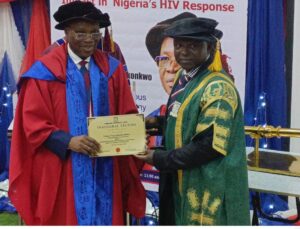



Prof. Haruna Ayuba, Vice–Chancellor, Bingham University, Karu, Nasarawa State, says Nigeria seems to have won the battle against HIV/AIDs through innovation in molecular science.
Ayuba stated this at the 14th Inaugural Lecture of the University, on Thursday in Karu, Nasarawa State.
The lecture was delivered by Prof. Prosper Okonkwo, a Professor of Infectious Disease and Epidemiology, Department of Community Medicine and Primary Health Care of the university.
The inaugural lecture is entitled: “Beyond Molecules: From Science to Sustainable Impact in Nigeria’s HIV Response”.
According to him, Nigeria has also won the battle against HIV/AIDS through innovation in vaccine research, antiretroviral therapies and diagnostic tools.
He said that these innovations have saved millions of lives and slowed the progression of the epidemic.
The vice chancellor said that the lecture, which promised to be both insightful and transformative, aimed at bridging the gap between laboratory discoveries and real-world applications.
He said that the war was yet to be over because scientific ingenuity and breakthroughs alone were insufficient to address the complex socio-economic and cultural factors influencing its transmission and treatment adherence in Nigeria.
“Achieving sustainable impact requires a multidimensional approach that integrates science with policy, education, community engagement and health system strengthening.
“It requires translating molecular research into accessible diagnostics, affordable treatment options and effective prevention strategies tailored to Nigeria’s diverse populations,” he said.
Ayuba appreciated Okonkwo for accepting to share his expertise and experiences as the 14th inaugural lecturer.
He urged other faculties that were yet to present their professors for inaugural lectures to step up on this cherished academic tradition.
“Your efforts demonstrated the strength and potential of our university and I also appreciated our esteemed guests and participants for coming.
“May this lecture inspire us all to continue to bridge the gap between science, policy and societal impact in ways that contribute to Nigeria’s progress in health and sustainable development,” he advised.
Also speaking, Okonkwo said Nigeria’s HIV response has proved that effective science and systems could save lives, but long-term success now depended on domestic financing, equity, institutional reliability and trust.
He noted that Nigeria has built one of the world’s largest HIV treatment programmes, expanding from about 15,000 people on treatment in its early years to more than 1.78 million people by 2023.
According to him, modern treatment is highly effective because a person who takes it consistently and maintains an undetectable viral load can live a long, healthy life.
According to him, such a person does not transmit HIV through sex, yet this progress has not ended the epidemic.
Okonkwo argued that Nigeria’s remaining challenges were increasingly about equity, financing and governance, rather than a lack of effective medicines.
“Thousands of children still acquire HIV each year; prevention services in pregnancy reached only about two-thirds of those who needed them in 2024.
“External partners financed 93 per cent to 96 per cent of HIV spending between 2019 and 2021.
” This can be achieved by reaching those still excluded from care, securing reliable domestic funding and protecting the systems that have saved millions of lives,” he said.
Also speaking, the Director-General of the National Agency for the Control of AIDS (NACA), Dr Temitope Ilori, urged academics to work closely with government and policymakers by providing indigenous research data to support effective policy formulation.
She congratulated Okomkwo and the university management, describing the lecture as excellent and expressed surprise at the institution’s growth during her first visit.
Also, the Vice-Chancellor of the University of Lagos, Prof Folasade Ogunsola, said the lecture showed the translation of evidence to practicality to impact and also gave us recommendations that were based on lessons learned.
Ogunsola, who congratulated the Vice-Chancellor of Bingham University, said that the University of Lagos was proud to be associated with the institution.
 Follow the MoneyCentral Nigeria channel on WhatsApp: Click here!