


Dangote Petroleum Refinery & Petrochemicals FZE has submitted an initial application to the Nigerian Securities and Exchange Commission (SEC) to execute a $5 billion Initial Public Offering (IPO) targeted for completion in October 2026, Reuters first reported citing a source with knowledge of the plan.
If approved, the equity issuance would stand as the largest public market listing in African capital markets history.
Proceeds from the offering are primarily earmarked to more than double the processing capacity of its single-train mega-refinery in Lekki, Lagos—from 650,000 barrels per day (bpd) to 1.4 million bpd—displacing India’s Jamnagar complex to become the world’s largest operating refinery.
A second source with direct knowledge of the deal told Reuters that Dangote Petroleum Refinery & Petrochemicals FZE, is expected to receive approval from the Nigeria SEC in the coming weeks and be able to publish a prospectus in September.
The first source said the IPO’s target was $5 billion but cautioned that the final figure would depend on what the Nigerian regulator approved as the primary listing will be on the Nigerian Stock Exchange.
That target would account for just over 4% of Nigeria’s main All Share Index, whose total capitalisation stood at $116 billion on Tuesday.
Pan-African Participation and Capital Structuring
Rather than pursuing dual or cross-listings on regional bourses, the transaction will leverage structured investment vehicles—such as Depositary Receipts (GDRs) and Exchange-Traded Instruments—to allow broader African capital markets to participate.
-
Regional Demand: Capital market authorities in South Africa, Kenya, Egypt, Ghana, and Rwanda have held preliminary discussions with financial advisers. Kenya’s domestic institutional investors and pension funds are projected to mobilize up to $500 million for the issue.
-
East African Footprint: In addition to the Lagos expansion, the group is evaluating a joint venture refinery along the Kenyan coast with East African regional governments.
-
Dual-Currency Flexibility: Investors will have the flexibility to subscribe to the offering and receive future dividend payouts in either U.S. Dollars or Nigerian Naira.
Global Valuation Benchmarks
The $40 billion valuation established during last month’s $2.5 billion private placement (where a 6% equity stake was carved out) puts Dangote Petroleum Refinery valued much higher than pure play refiners, but closer in valuation to global integrated energy and petrochemicals peers.
A slightly higher multiple for the IPO of $50 billion means that a 10% equity float translates to a $5 billion capital raise, making it the largest initial public offering in African capital market history.
However, matching a $50 billion tag against an estimated EBITDA benchmark of $2.8 billion yields an implied Enterprise Value-to-EBITDA (EV/EBITDA) multiple of 17.9x.
This prices the single-site Lekki asset at a massive premium to the world’s most diversified downstream majors, presenting institutional investors with a fundamental question: Is Dangote being valued as a cyclical fuel processor, or as an irreplaceable regional infrastructure monopoly?
A $50 billion Dangote Refinery valuation would sit far above the market values of major listed refiners in the U.S., India and China, and would imply a multiple more akin to an integrated energy and petrochemicals platform than a plain-vanilla fuel processor.
Simple valuation math
On a rough basis, a $50 billion valuation for a 650,000 bpd asset implies about $76,900 per barrel/day of installed capacity. That is high for a stand-alone refinery asset, but less unusual if investors value Dangote as a vertically integrated platform with refining, petrochemicals, logistics and distribution optionality.
By comparison, Marathon Petroleum’s roughly $74.34 billion equity value reflects a diversified U.S. refining business with a much larger corporate footprint than a single site. Sinopec’s $88.28 billion market cap also reflects an integrated downstream and chemicals group rather than a pure refining asset.
What the premium implies
The market would likely be pricing several things beyond current refining earnings: scarcity value, scale, import substitution in Nigeria, petrochemical upside and the possibility of regional export dominance. A $50 billion tag also suggests Dangote may be seeking valuation support from growth expectations rather than current peer-multiple parity.
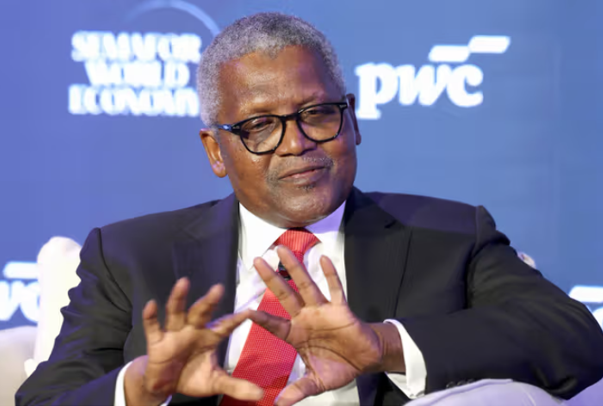
Dangote in a recent interview told MoneyCentral that the listing is intended to give smaller investors a chance to participate in the refinery’s long-term growth, comparing the opportunity to early investors in global growth names such as Apple.
“We want ordinary Africans to participate in the value being created,” Dangote said. “What companies like Amazon and Apple achieved globally in terms of wealth creation is what we seek to replicate in Africa. We want people to invest, grow with us, and share in the prosperity.”
Expansion Within and Beyond Nigeria
In April, 2026 the Dangote Petroleum Refinery announced a landmark $4 billion financing agreement to accelerate its expansion into the fuel and petrochemical sectors.
This strategic capital injection, led by the African Export-Import Bank (Afreximbank), arrives as the facility reached full nameplate capacity and sought to dominate the African energy market amidst the supply vacuum left by the Middle East conflict.
The expansion targets the production of polypropylene and polyethylene, the raw materials for the plastics industry.
The growth push matters because listed refiners are usually valued on earnings volatility, margins and capital intensity, which can compress valuation multiples when crack spreads normalize.
A refinery IPO at this level would therefore need either very strong cash generation or a convincing story around integrated downstream earnings, growth and regional demand, to justify the gap.
Dangote has also outlined plans for a proposed East Africa refinery with capacity of 700,000 barrels a day, alongside polypropylene and base oil plants.
The project was not originally included in the group’s Vision 2030 strategy, suggesting Dangote is moving beyond earlier expansion goals as demand across the continent remains strong.
 Follow the MoneyCentral Nigeria channel on WhatsApp: Click here!