
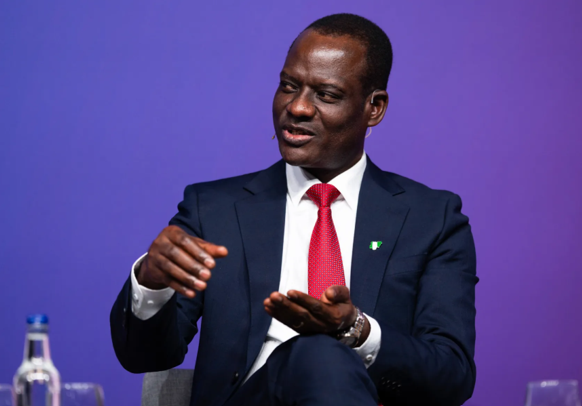



Nigeria’s economy is worth about $2.4 trillion when measured by purchasing power parity (PPP), making it the world’s 19th-largest, Finance Minister Taiwo Oyedele told a Chatham House event in London on Oct. 21.
He used the figure to sell the country’s consumer market to foreign investors as the International Monetary Fund’s (IMF) October 2026 projections put the country’s GDP measured by PPP at $2.44 trillion international dollars, placing it between Egypt in 18th place and Taiwan in 20th.
Nigeria’s output is also more than twice South Africa’s $1.08 trillion international dollars.
In nominal dollar terms the picture is very different. The same IMF data put Nigeria’s economy at $386.67 billion, 48th in the world, with income per head of $1,594.
“The next phase of growth will be financed by private capital, domestic and foreign, and not by the state borrowing more,” Oyedele said.
Demand that is often underestimated
PPP adjusts output for the fact that a naira buys far more locally than its market exchange rate suggests.
Nominal per-capita income of $1,594 suggests a very poor market. However, when measured by purchasing power, the figure is about $10,051, so the average Nigerian can buy far more than the dollar number implies.
Companies selling everyday products priced in naira, such as noodles, data bundles, cement and beer, are selling into a much larger market than the dollar headline suggests.
Put simply, food, transport, rent, labour and services cost much less in Nigeria than in the US.
For investors, the PPP figure measures how much Nigerians actually produce and consume. On that basis Nigeria’s 242 million people form Africa’s largest consumer market for food, telecoms, banking, cement and household goods.
Low local costs also favour manufacturers and service firms that produce in Nigeria for export.
The government says investors are already responding. Capital importation rose to $10.37 billion in the first quarter of 2026 from $1.13 billion three years earlier, and foreign direct investment reached $4.01 billion in 2025, the Federal Ministry of Information said.
Limits to PPP Measurements
PPP measurements for an economy however has its limits, though.
Foreign investors earn in naira but measure returns in dollars, euros or pounds, so the nominal economy and the exchange rate decide what they can take home.
The gap between Nigeria’s PPP and nominal rankings is largely the result of the naira’s devaluations since 2023.
Income per head on a PPP basis is also less than half of Egypt’s, which makes Nigeria a large but low-income market where shoppers are highly sensitive to price and companies must sell small, cheap units, with margins thin when costs rise.
For investors, the PPP number is best read as a measure of how many potential customers and how much demand Nigeria has.
The nominal number is a measure of what that demand is currently worth in hard currency. The case for investing rests on narrowing the gap between the two, through a stable naira, lower inflation and rising incomes, which would help translate Nigeria’s purchasing-power scale into dollar returns.
 Follow the MoneyCentral Nigeria channel on WhatsApp: Click here!

, making it the world's 19th-largest)