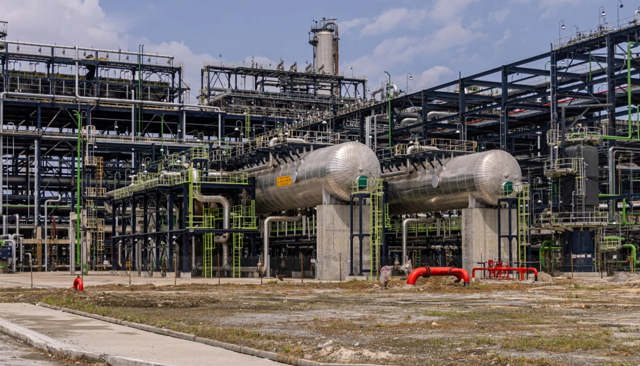



In a major step toward total energy self-sufficiency, the Dangote Group has officially commenced production from its upstream oil assets.
Devakumar Edwin, Vice President of Oil and Gas, confirmed in an April 17, 2026, interview with Platts (S&P Global) that the group has achieved “first oil” from its Niger Delta licenses and is transitioning from testing to marketable production.
This move addresses the refinery’s Achilles’ heel: crude supply security. Despite its 650,000 bpd capacity, the refinery has often struggled with consistent local feedstock, at one point receiving only 5 of its 15 contracted monthly cargoes from NNPC.
Upstream Targets: OML 71 and 72
The production is centered on Oil Mining Leases (OML) 71 and 72, located in the shallow waters of the Niger Delta. Dangote’s upstream venture, West African E&P, holds an 85% stake in the joint venture alongside First E&P.
-
Standard Well Testing: Testing is expected to conclude within the next 3 to 4 weeks, after which oil will be pumped in larger, commercial volumes.
-
Drilling Campaign: The group has already secured a rig to begin a new drilling campaign, signaling a transition from mere “re-entry” of old wells to active exploration and expansion.
Business Integration: Shipping Expansion
To complement its upstream and downstream assets, the Dangote Group is establishing its own shipping and logistics arm. This vertical integration is designed to eliminate the “middleman” costs that have historically plagued Nigerian oil logistics.
-
Reducing “War Premiums”: By owning its vessels, Dangote can bypass the fluctuating freight rates caused by the Iran-Israel-U.S. conflict, which have seen global shipping costs rise by over 40% since February.
-
Reliability: CEO David Bird noted that having a dedicated shipping presence ensures that crude from the Niger Delta reaches the Lekki Free Zone without the delays common in third-party chartering.
-
Cost Efficiency: Shipping its own crude allows the refinery to protect its “cracking margins,” especially as it ramps up high-value Jet A1 exports to Europe.
The $40 Billion Ecosystem
The upstream startup is a piece of a much larger puzzle. Aliko Dangote’s vision for 2026–2030 includes:
-
Refinery Expansion: Moving from 650,000 bpd to 1.4 million bpd to become the world’s largest single-site refiner.
-
Petrochemical Dominance: Doubling polypropylene output and entering the Linear Alkylbenzene (LAB) market for detergents.
-
African IPO: Listing 10% of the refinery across multiple African exchanges to fund further growth in DRC (Potash) and Zambia (Copper).
 Follow the MoneyCentral Nigeria channel on WhatsApp: Click here!