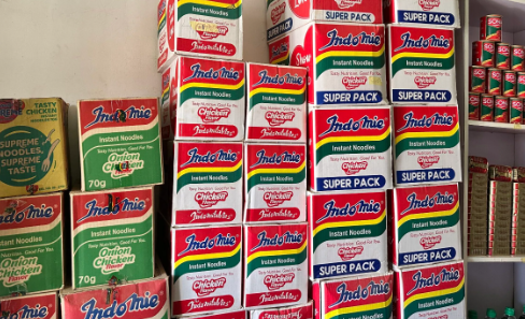



Dufil Prima Foods Limited has cemented its dominant market position in Nigeria’s noodles sector, accounting for over 60% market share, which has underpinned sustained revenue growth and strong cash generation despite intensifying cost pressures in recent times.
Revenue grew 30% to ₦1.1 trillion ($697.3 million) in 2025, supported by inflation-induced price reviews and gradual volume recovery, according to data seen by MoneyCentral.
However, rising cost pressures from higher input costs and elevated marketing expenses targeted at boosting sales volume translated to a contraction in both absolute EBITDA and EBITDA margin to ₦84.5 billion (2024: ₦92.7 billion) and 8% (2024: 11.4%) respectively in 2025.
Market position
Dufil’s competitive position is anchored on its leading market position in Nigeria’s noodles industry, where it accounts for over 60% market share.
The group benefits from a strong customer base, an extensive distribution network and consistent promotional activities that have strengthened brand equity and deepened market penetration. Strong shareholder support continues to underpin supply chain stability and foster ongoing product development, sustaining the brand’s appeal to young demographics in Nigeria.
Revenue concentration
These strengths are partly offset by high revenue concentration, with noodles accounting for more than 74%, while other business lines—including flour, pasta, snacks, packaging and palm oil—contribute a combined 26% in 2025. Analysrs expect noodles to remain a dominant contributor to topline, supported by plans to expand noodle production capacity in 2026.
Nevertheless, the completion of the flour plant expansion in Q3 2026 is expected to modestly increase the contribution of the flour business and support margins in the snacks segment.
Future outlook
Given the recently established pricing base, with no expectation of broad-based price increases in the near term, analysts expect future revenue growth to largely be driven by higher traded volume on the back of the proposed increase in production capacity. This, combined with more stringent cost control measures as evidenced during Q1 2026, should contain EBITDA margins around 9% over the outlook period.
Debt management
The leverage and capital structure assessment remains negative though evidencing improving debt management lately. Gross debt reduced to ₦96.2 billion on 31 December 2025 (31 December 2024: ₦163.6 billion) and further to ₦79.6 billion in Q1 2026, driven by management efforts to deleverage its balance sheet from expensive borrowings.
The modest debt level, complemented by substantial cash balances and sustained robust earnings, translated to an improvement in leverage metrics.
Liquidity position
The liquidity position has slightly improved on robust cash holding of ₦44.6 billion (including restricted cash of ₦20.8 billion) as of March 2026, adequate to cover the anticipated short-term debt obligations of ₦47.9 billion over the next nine-month period to 31 December 2026.
Although refinancing risk remains high with short-term debt accounting for above 40% of total debt, liquidity is further supported by sizable, unutilized committed facilities of ₦106.5 billion indicating the company’s wide access to funding sources.
The anticipated higher capital spending of ₦32.5 billion over the next 21 months to December 2027, as well as projected higher dividend payments in view of robust prior-year profits, is sufficiently covered by the projected robust operating cash flow.
Outlook
Dufil Prima Foods’ 60% noodles market share provides a durable competitive moat, but the company’s heavy revenue concentration in a single product line exposes it to volume shocks and pricing pressure.
The 30% revenue growth in 2025 was driven primarily by price increases rather than volume, and with no broad-based price increases expected in the near term, future growth will depend on production capacity expansion and market share gains.
The flour plant expansion completion in Q3 2026 should modestly diversify revenue and support snacks segment margins, but noodles will remain the dominant revenue driver. Investors and creditors will monitor the company’s ability to execute its production capacity expansion while maintaining EBITDA margins around 9% in an environment of elevated input costs and marketing expenses.
Financial performance
| Metric | 2025 | 2024 | Change |
|---|---|---|---|
| Revenue | ₦1.1 trillion | ₦846 billion | +30% |
| Revenue (USD) | $697.3 million | $564 million | + 23.6% |
| EBITDA | ₦84.5 billion | ₦92.7 billion | -9% |
| EBITDA margin | 8% | 11.4% | -3.4ppt |
| Gross debt (Dec 2025) | ₦96.2 billion | ₦163.6 billion | -42% |
| Gross debt (Q1 2026) | ₦79.6 billion | — | -17% (QoQ) |
| Net debt to EBITDA | <1x | 1.4x | Improved |
| EBITDA interest coverage | 3.9x (2025) | 2.8x | +1.1x |
| EBITDA interest coverage (Q1) | 5.2x (Q1 2026) | — | +1.3x (QoQ) |
| Operating cash flow coverage | 91% (2025) | Negative (2024) | Turned positive |
| Operating cash flow coverage | 128% (Q1 2026) | — | +37ppt (QoQ) |
| Cash balances | ₦44.6 billion | — | — |
| Short-term debt | ₦47.9 billion | — | — |
| Unutilized facilities | ₦106.5 billion | — | — |
| Capital spending (21-month) | ₦32.5 billion | — | — |
Source: MoneyCentral, Company data
 Follow the MoneyCentral Nigeria channel on WhatsApp: Click here!