
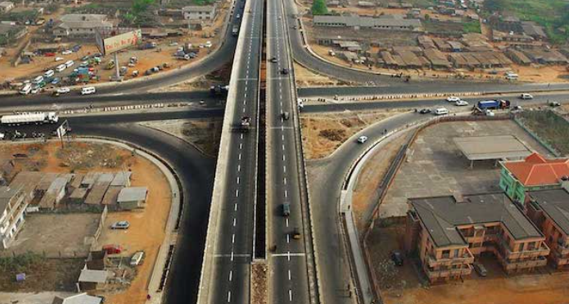



Nigerian states received more FAAC inflows leading to total revenue of N13.8 trillion in 2024, than the Federal Government (N12.3 trillion) and as a result embarked on a spending spree to build badly needed infrastructure.
States are experiencing a fiscal surplus on aggregate, albeit with significant variation.
Based on data compiled from various Budget Implementation Reports (BIRs), a total of 34 Nigerian states recorded an aggregate surplus of approximately N1.6 trillion (0.6 percent of GDP) in 2024, significantly higher than the N437 billion (0.2 percent of GDP) surplus in 2023, according to a World Bank biannual development report on Nigeria released on Monday.
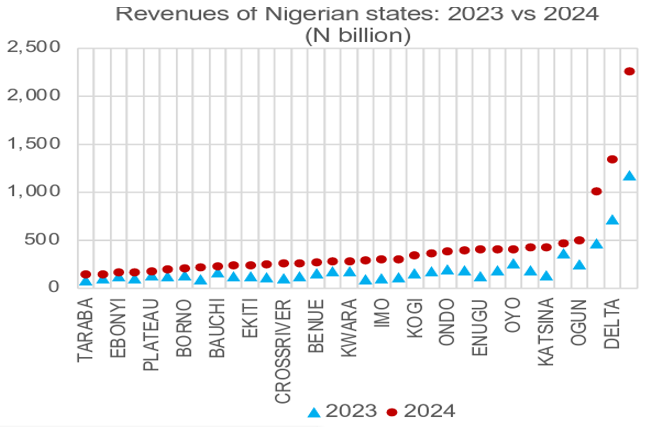
While most states maintained a near-balanced fiscal position, some, such as Niger and Ebonyi, recorded fiscal deficits, whereas others—mainly oil-producing states like Ondo, Akwa Ibom, and Delta—reported large surpluses.
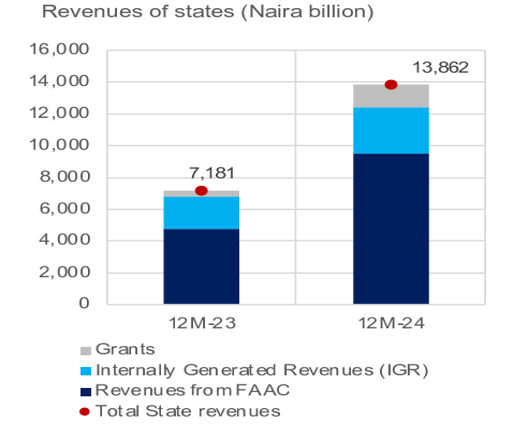
The improved fiscal position at the state level in 2024 stems from significantly higher revenues, driven in part by large refunds to states that had been deducted from FAAC.
Revenues for the 34 states with available BIRs surged from N7.2 trillion in 2023 (3.1 percent of GDP) to N13.9 trillion in 2024 (5 percent of GDP).
The seven oil-producing states—Abia, Akwa Ibom, Bayelsa, Delta, Edo, Imo, and Ondo—benefited the most from the FAAC windfall, accounting for 31 percent of the total revenue increase in 2024.
In addition to the FAAC increase, state Internally Generated Revenues (IGR) grew by 46 percent, reaching N2.9 trillion (1 percent of GDP), while grants and aid nearly tripled to N1.5 trillion (0.5 percent of GDP), further strengthening state finances.
Given the significant fiscal space created by the surge in revenues, states have substantially increased their spending, primarily on capex.
State expenditures rose from N6.7 trillion in 2023 (2.9 percent of GDP) to N12.2 trillion (4.4 percent of GDP) in 2024, driven almost entirely by higher capex, which more than doubled from N3.3 trillion in 2023 to N7.4 trillion in 2024.
This increase reflects the very large infrastructure gap, which many states suffer from.
Sectoral data reflect this trend, with capital-intensive sectors such as transport, agriculture, mining, housing, and other industries seeing spending increases of over 100 percent, most of which is devoted to capex.
Meanwhile, social sectors – including social protection, education, and health – also saw notable spending growth, albeit at lower rates of 57, 63, and 75 percent, respectively.
States have been spending on infrastructure improvements across the 6 geopolitical zones.
In a recent Arise TV interview, Governor Alex Otti of Abia State told Rufai Oseni that the total cost of the Julius Berger contract for Port Harcourt Road Aba was N36 billion.
The Enugu State government allocated a total of N183 billion for the construction of 141 urban roads and 20 rural roads across the state. Additionally, N55 billion was allocated for the construction, reconstruction, and rehabilitation of urban and rural roads in the 2025 fiscal year.
In 2024, the Lagos State government allocated N550.689 billion for infrastructure development and maintenance.
This amount represents 24.28% of the entire state budget.
The funding will support ongoing transportation projects, including the expansion of the rail network, road construction, and completion of the Blue and Red Lines. Additionally, the state allocated N55.924 billion for affordable housing and urban renewal projects.
The Kaduna State Government awarded 78 road projects totaling 775Km in the last 21 months to March 2025, with 21 of the roads already completed and in use.
The Commissioner of Public Works and Infrastructure, Ibrahim Hamza, disclosed this at the Quarterly Ministerial Press Briefing at Sir Kashim Ibrahim House, Kaduna.
In 2024, Delta State, Nigeria, had a proposed budget of N714.4 billion, which includes various road projects and other development initiatives, according to the state government.
 Follow the MoneyCentral Nigeria channel on WhatsApp: Click here!
)