

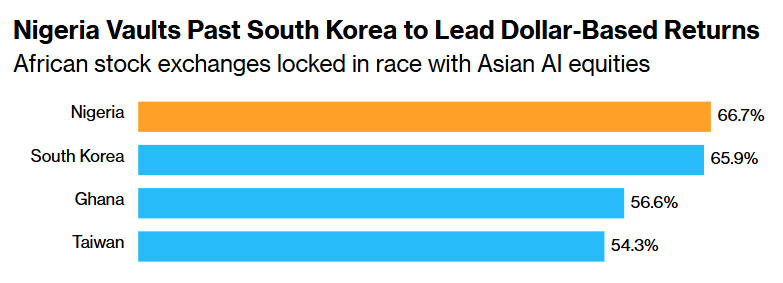
Nigerian equities have overtaken South Korea to secure the highest dollar-based returns in the world this year. The milestone arrives as cooling international sentiment on artificial-intelligence hardware components pushes the Asian nation’s previously white-hot equity market into a technical bear market.
According to index data compiled by Bloomberg tracking 92 global stock exchanges, the benchmark index in Africa’s largest oil producer has posted a spectacular 67% return in dollar terms year-to-date.
That performance pulls it just ahead of South Korea’s benchmark Kospi index, which has seen its year-to-date dollar gains compressed to 66% following a severe tech-driven liquidation.
The stark divergence underscores a broader macro rotation. While the export-heavy Kospi plunged into an official bear market this week—shedding 22% of its value since its June 19 peak as global asset managers pulled out of semiconductor heavyweights—the Lagos-based bourse has remained completely insulated from global tech anxieties.
Insulated From the Silicon Valley Shock
The core of Nigeria’s investment appeal lies in its absolute lack of direct exposure to the hyper-volatile artificial intelligence supply chain.
While South Korea’s equity markets and the won—which has weakened 5% year-to-date—suffer from systemic questions regarding the long-term commercial sustainability of AI infrastructure capital expenditures, buyers on the Nigerian Exchange (NGX) are trading on entirely different micro and macro catalysts.
Domestic financial services firms and insurance counters have aggressively led the local index expansion. Most notably, Fortis Global Insurance Plc has handed global portfolio managers outsized, near-unprecedented returns of 1,400% in dollar terms over the period, highlighting the intense domestic accumulation sweeping through the financial sector.
A Structural Reform Tailwind
The underlying foundation powering the 67% dollar rally is a combination of continuous domestic macroeconomic reforms, structurally elevated oil prices, and vastly improved liquidity within the official foreign-exchange window.
Unlike previous commodity booms where local equity gains were rapidly cannibalized by currency depreciation, the Central Bank of Nigeria’s hawkish monetary tightening has successfully stabilized the local currency.
The Naira has clawed back 4% against the greenback since January, meaning international investors are capturing pure capital appreciation without seeing their returns eroded by foreign exchange translation losses.
Institutional momentum received a secondary boost following announcements that S&P Dow Jones Indices is formally considering upgrading Nigeria out of its “Standalone” category back into its premier Frontier Market index.
This potential regulatory reclassification is coinciding with intense pre-IPO positioning. Global asset managers are aggressively building liquidity buffers ahead of the highly anticipated dual-listing Initial Public Offering (IPO) of the Dangote Petroleum Refinery, a megaproject poised to become the largest single equity listing in African capital market history.
With the global tech trade experiencing structural headwinds, Nigeria’s reform-driven industrial and financial landscape has evolved from a frontier afterthought into a high-yielding sanctuary for global macro allocators seeking structural growth decoupled from Wall Street’s tech valuations.
 Follow the MoneyCentral Nigeria channel on WhatsApp: Click here!