
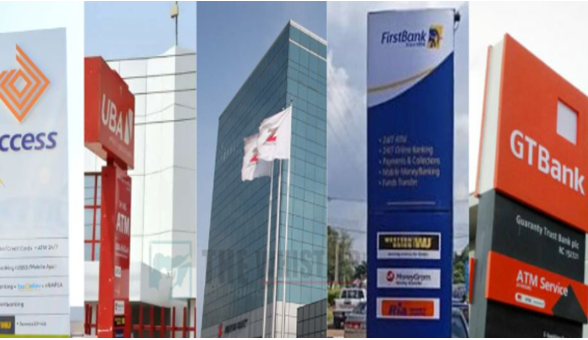



Nigeria’s largest lenders mobilized ₦137.34 trillion ($100.9 billion) in deposits from customers as at the first quarter of 2026, 2.1% higher than the levels as at December 2025, with Access Holdings topping the list and Fidelity Bank posting the highest loan-to-deposit ratio among the top 10 banks.
Top 10 banks by customer deposits (Q1 2026)
| Rank | Bank | Deposits (₦ trillion) | Deposits ($ billion) |
|---|---|---|---|
| 1 | Access Holdings | 34.56 | 25.33 |
| 2 | Zenith Bank | 24.47 | 17.94 |
| 3 | United Bank for Africa (UBA) | 24.14 | 17.70 |
| 4 | FirstHoldCo Plc | 18.38 | 13.46 |
| 5 | Guaranty Trust Holding Company (GTCO) | 13.20 | 9.66 |
| 6 | Fidelity Bank | 7.38 | 5.43 |
| 7 | Stanbic IBTC Holdings | 4.08 | 2.98 |
| 8 | FCMB* | 4.40 | 3.22 |
| 9 | Wema Bank | 3.40 | 2.49 |
| 10 | Sterling Bank | 2.94 | 2.15 |
| Total | Top 10 | 137.34 | 100.90 |
*FCMB figure is as at December 2025. Source: MoneyCentral, exchange rate ₦1,360/USD
Deposit growth
Stanbic IBTC and Sterling Bank had negative deposit growth of -6.6% and -1.30% in the period, respectively, while the rest of the top 10 banks posted positive growth.
Loan-to-deposit ratios (Q1 2026)
| Bank | LDR (%) |
|---|---|
| Fidelity Bank | 63.0 |
| Stanbic IBTC Holdings | 60.7 |
| Wema Bank | 54.7 |
| FirstHoldCo Plc | 51.3 |
| Sterling Bank | 49.1 |
| Zenith Bank | 46.5 |
| Access Holdings | 38.7 |
| United Bank for Africa (UBA) | 29.6 |
| Guaranty Trust Holding Company (GTCO) | 24.0 |
*FCMB Group had an LDR of 52% as at December 2025. Source: MoneyCentral
What LDR means
The Loan-to-Deposit Ratio (LDR) is a core financial metric used to evaluate a bank’s liquidity and lending risk by comparing its total outstanding loans to its total customer deposits. It reveals whether a bank is managing its core funds prudently or taking on too much risk to boost profits.
A high LDR can increase interest income but may pose liquidity risks, while a low LDR can ensure safety but limit income opportunities.
Analysis
Fidelity Bank’s 63% LDR signals aggressive lending relative to its deposit base, which could boost interest income but exposes the bank to liquidity pressure if deposit withdrawals surge. In contrast, GTCO’s 24% LDR reflects a conservative approach with substantial liquidity buffers but limited income generation from lending.
The top three deposit holders—Access Holdings, Zenith Bank and UBA—collectively control 56% of the top 10’s total deposits, highlighting the concentration of funding power among Nigeria’s mega-banks.
This concentration gives them significant pricing advantage in deposit competition and strengthens their ability to fund large corporate lending.
The negative deposit growth at Stanbic IBTC and Sterling Bank could signal customer outflows to higher-yielding alternatives or competitive pressures from banks offering more attractive deposit rates. Investors will monitor whether these declines are temporary or indicative of deeper funding challenges.
The 2.1% quarter-on-quarter deposit growth suggests stable deposit mobilization despite the high-interest environment, though the pace remains modest compared to the rapid loan growth some banks are pursuing. Banks with LDRs above 50%—Fidelity, Stanbic IBTC, Wema and FirstHoldCo—will need to balance their lending appetite with deposit growth to avoid liquidity strain.
 Follow the MoneyCentral Nigeria channel on WhatsApp: Click here!
 in deposits from customers as at the first quarter of 2026)