
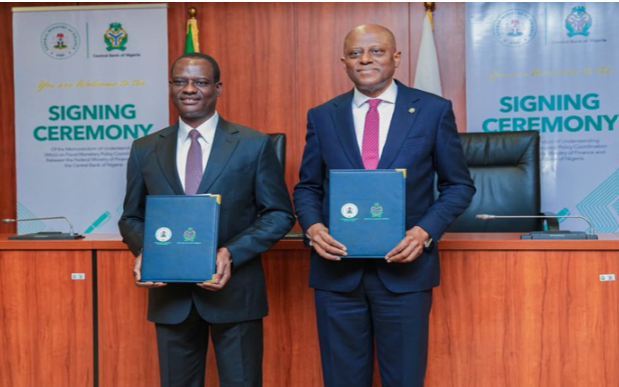



In a structural move to eliminate policy misalignment and strengthen long-term economic governance, the Federal Ministry of Finance and the Central Bank of Nigeria (CBN) signed a bilateral Memorandum of Understanding (MoU) on Friday, September 18, 2026, in Abuja.
The agreement—executed by the Minister of Finance and Coordinating Minister of the Economy, Taiwo Oyedele, and CBN Governor Olayemi Cardoso—establishes a binding institutional framework for coordinated debt issuance, liquidity forecasting, government cash management, and synchronized inflation management.
The initiative seeks to transition fiscal-monetary cooperation from ad-hoc operational relationships dependent on individual office holders into a permanent, data-driven system while preserving the operational independence of the central bank.
Strategic Rationale & Economic Impact
-
Institutionalizing Fiscal-Monetary Alignment: The framework addresses structural frictions where uncoordinated government spending or primary market borrowing schedules previously complicated the central bank’s liquidity management. By aligning Treasury cash management directly with OMO and T-bill issuance schedules, the authorities aim to optimize system liquidity and lower sovereign debt-servicing costs.
-
Support for Inflation-Targeting Transition: As the CBN advances its operational shift toward an explicit inflation-targeting framework, the MoU establishes a shared data base with the National Bureau of Statistics (NBS) and the Ministry of Finance. Fiscal commitments to address non-monetary inflation drivers—such as grain reserves, farm-to-market logistics, and supply-side agricultural bottlenecks—are structured to complement CBN interest rate policy.
-
Mitigating Private Sector Crowding-Out: Structured debt issuance planning under the agreement aims to streamline domestic borrowing. By synchronizing government liquidity demands against commercial banking sector reserves, the framework ensures adequate credit expansion remains available for private enterprise growth.
 Follow the MoneyCentral Nigeria channel on WhatsApp: Click here!
 on Friday, September 18, 2026, in Abuja)