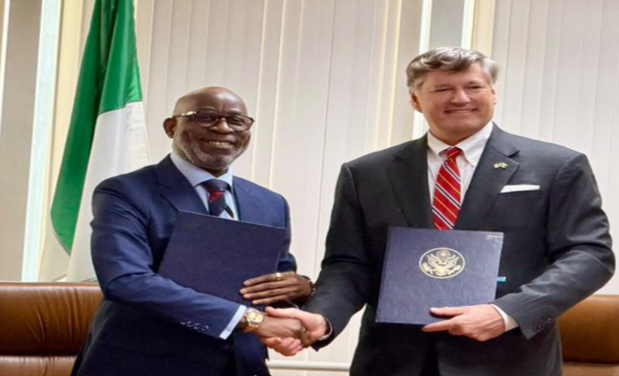



Nigeria and the United States (U.S.) have signed a bilateral mining investment framework agreement aimed at unlocking American capital to develop Nigeria’s estimated $700 billion solid minerals sector.
The agreement was executed and exchanged at the Nigerian Mission House in New York on the sidelines of the 81st United Nations General Assembly (UNGA) by Nigeria’s Minister of Solid Minerals Development, Dele Alake, and U.S. Deputy Secretary of State, Christopher Landau.
The framework serves as an institutional bridge to facilitate business-to-business (B2B) transactions and promote local processing, moving Nigeria away from its historical role as a exporter of unprocessed critical minerals.
Strategic Rationale & Economic Impact
-
Enforcing In-Country Value Addition: Minister Dele Alake reiterated Nigeria’s firm stance against raw material extraction without local processing. The agreement prioritizes setting up refining plants, transfer of technology, and local job creation, aligning with Nigeria’s policy mandate that bans the export of unprocessed lithium, cobalt, and other critical minerals.
-
Securing Critical Mineral Supply Chains: U.S. Deputy Secretary Christopher Landau stated that the United States recognizes Nigeria as a key regional energy partner. The pact provides American companies with structured access to secure, ethically sourced critical minerals required for green energy transition technologies while supporting local industrialization.
-
Transition to Project Commercialization: Both delegations confirmed that implementation will immediately pivot toward identifying viable projects, mobilizing private equity capital, and executing commercial joint ventures.
 Follow the MoneyCentral Nigeria channel on WhatsApp: Click here!