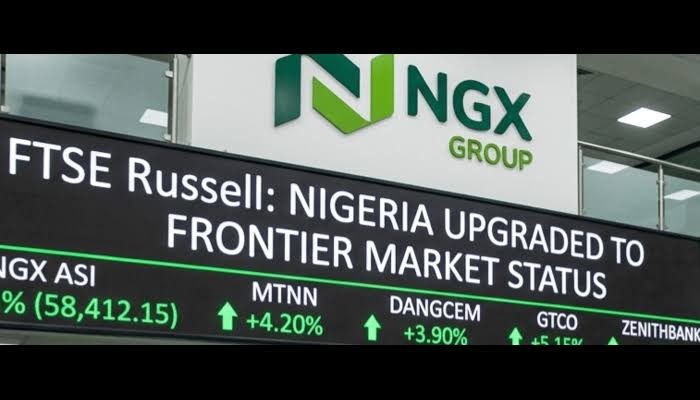



Nigeria’s biggest and most liquid shares are set to return to the radar of frontier-market investors after FTSE Russell confirmed the country will regain Frontier Market status from Sept. 21, ending a three-year exclusion driven by foreign-exchange and capital-repatriation concerns.
MoneyCentral estimates that Nigeria’s return to FTSE Russell’s Frontier Market category could generate as much as $170 million in passive buying if the country secures a 17% free-float-adjusted benchmark weight and assets tracking the index reach $1 billion.
Because passive funds generally try to minimize tracking error, much of this demand could be executed near the implementation date rather than smoothly through the quarter.
CardinalStone Research has identified those names as the most likely early beneficiaries of improved investor sentiment, while flagging Aradel Holdings as a potential addition given material changes in the Nigerian market since 2023.
The reclassification makes Nigerian shares eligible again for FTSE Frontier Index Series inclusion.
It does not, by itself, guarantee a large wave of buying: active managers retain discretion, and the size of compulsory passive flows will depend on Nigeria’s final FTSE country weight, constituent eligibility, free-float factors and the benchmark assets actually tracking the index.
Likely beneficiaries
The first screen for potential inclusion is not simply market capitalization. FTSE’s methodology generally favors companies with sufficient free float, liquidity and foreign-investor accessibility. This makes the likely beneficiaries different from a simple list of Nigeria’s largest listed companies.
| Likely rank | Stock | Why it may benefit | Primary catalyst |
|---|---|---|---|
| 1 | GTCO | One of Nigeria’s most liquid bank shares, with broad foreign-investor familiarity and significant regional profile | Financial-sector proxy; high turnover and institutional visibility |
| 2 | Zenith Bank | Large, liquid, widely held banking franchise with strong index suitability | Bank recapitalization and earnings re-rating |
| 3 | MTN Nigeria | Major telecommunications name with deep domestic relevance and institutional scale | Large-cap, defensive earnings and digital-services exposure |
| 4 | Dangote Cement | Dominant Nigerian industrial and materials company | Infrastructure, construction and naira-revenue exposure |
| 5 | Seplat Energy | Dollar-linked energy producer with London and NGX listings | Oil production, dollar earnings and international-investor familiarity |
| 6 | Nestlé Nigeria | Global consumer brand and likely candidate if liquidity/free-float thresholds are satisfied | Consumer recovery and imported-input normalization |
| 7 | Aradel Holdings | Potential future addition rather than a confirmed candidate | Newer market scale, oil exposure and evolving investability profile |
| 8 | UBA / Access Holdings / First HoldCo | Possible banking-sector spillover, subject to final screening | Liquidity and broad domestic financial exposure |
The first six names are the shares specifically highlighted by CardinalStone as likely sentiment beneficiaries; Aradel was identified as a potential eventual addition. Final FTSE eligibility has not yet been published.
Flow scenarios
Dedicated passive index-tracking funds and exchange-traded funds (ETFs) holding assets tied directly to the FTSE Frontier Index Series command a relatively modest asset base—estimated around several hundred million to roughly a billion dollars globally.
Assuming Nigeria receives a 15% to 17% free-float-adjusted weight after re-entry, passive funds tracking $500 million to $1 billion of FTSE Frontier assets could need to allocate $75 million to $170 million to Nigerian equities. If that positioning is spread over three months around the Sept. 21 effective date, implied monthly passive demand rises to roughly $25 million to $56.7 million, with a base case of about $40 million a month.
| Scenario | Global FTSE Frontier tracker assets | Assumed Nigeria free-float-adjusted weight | Passive allocation required | Estimated monthly flow over 3 months |
|---|---|---|---|---|
| Conservative | $500 million | 15% | $75.0 million | $25.0 million |
| Base case | $750 million | 16% | $120.0 million | $40.0 million |
| Bull case | $1.0 billion | 17% | $170.0 million | $56.7 million |
Source: MoneyCentral
Why banks may lead
Banks are likely to be among the clearest beneficiaries because the sector combines liquidity, broad foreign familiarity and a direct link to Nigeria’s macro normalization. GTCO and Zenith were the two lenders identified by CardinalStone as likely to see immediate traction from the country’s return.
The principal risk is that Nigeria’s return produces a re-rating story rather than an immediate large passive-flow event. FTSE Frontier benchmarks are smaller than emerging-market benchmarks, so the longer-term value of reclassification may be the return of active managers, research coverage, liquidity and credibility rather than a one-day index-buying surge.
 Follow the MoneyCentral Nigeria channel on WhatsApp: Click here!