


…as Fuel Shock Wipes Out 2025 Profit
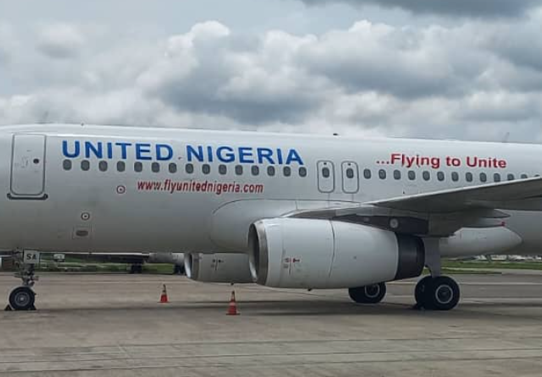
United Nigeria Airlines Co. is asking investors for as much as N20 billion in short-term Commercial Paper (CP) debt, even as the carrier swung to a N13.3 billion first-half loss and its debt rose more than twentyfold in six months, while its equity shrank by a third.
The Enugu-based airline has opened Series 1 and Series 2 of a N100 billion commercial paper programme, with tenors of 270 and 364 days, to fund working capital, according to its September investor presentation, seen by MoneyCentral.
Commercial paper is short-term debt that must be repaid within a year.
From Record Profit to Loss
In 2025, United Nigeria earned N23.8 billion profit after tax on revenue of N90.8 billion, a 26.2% net margin. Gross margin widened to 38.3% from 19.1%, and return on equity reached 61%.
The first half of 2026 however saw a marked reversal of fortunes for the airline. Revenue climbed to N97.7 billion, already 7.6% more than in all of 2025.
But direct operating costs reached N99.8 billion, leaving a gross loss of N2.1 billion. The net loss was N13.35 billion, a negative margin of 13.7%, according to the unaudited management report signed by Financial Controller Sunday Ukpe.
The deterioration was concentrated in the second quarter of 2026 as revenue fell 4.8% from the first quarter and passenger numbers dropped 10% to 324,980.
Direct costs rose to 118% of revenue, and the quarter’s loss of N15.3 billion more than wiped out all of the first-quarter profit.
Fuel Shock and Debt Bill
Management blames the Iran-US conflict, which it says pushed Jet A1 aviation fuel from about N900 a litre to N2,800 between March and mid-June without a matching rise in fares.
Fuel spending reached N43 billion against a N25.7 billion budget and fuel costs rose 49% from the first quarter to N25.9 billion in the second. Lease costs added another N40.8 billion in the half.
Borrowings rose to N115.5 billion at June from N5 billion at the end of 2025.
The borrowing paid for more aircrafts as owned aircraft on the balance sheet rose to N119 billion from N10.2 billion at the end of 2025. They were funded by N72 billion from Zenith, N36 billion from Fidelity Bank Plc and N5 billion from the Bank of Industry. Total assets more than doubled to N167.3 billion.
Finance costs jumped to N6.29 billion in the second quarter from N173 million in the first. Debt to equity rose to about 4.5 times, and would reach about 5.3 times with the new paper, on MoneyCentral calculations.
Cash was N15.1 billion at June, less than the amount being raised.
Why Investors Should Be Careful
- Earnings quality. In 2025, operating cash flow of N15.1 billion was only about 63% of net income, as receivables jumped to N31.9 billion. At June, receivables included an N18.2 billion “loan refund receivable” that the report does not explain.
- Refinancing risk. The paper must be repaid within 12 months by a company that lost money in the most recent half and now carries N115 billion of bank debt.
- A Zenith-linked adviser. Quantum Zenith Capital & Investments Ltd., an affiliate of Zenith Bank is among the issuing houses. Zenith is the airline’s largest lender. It could be a conflict of interest.
- Unaudited, without comparison. The H1 figures are management accounts. They give no first-half 2025 comparison and include no auditor’s review.
Bull Case

The airline has growth momentum. It flew 686,256 passengers in the first half, more than in all of 2025. It flew the second-most flights among Nigerian carriers, 6,852 against Air Peace’s 7,687. Two more Boeing 737-800s began flying in July, and management says fuel prices have since normalised. It also holds IOSA safety certification and has approval for six international destinations.
But investors are being asked to lend for up to a year on the strength of a 2025 profit that the first half has erased.
Prof. Obiora Okonkwo, OFR owns 5.699 billion shares or 95% of United Nigeria Airlines, while Mazi Ositadinma Okonkwo owns 300 million shares or 5%.
 Follow the MoneyCentral Nigeria channel on WhatsApp: Click here!