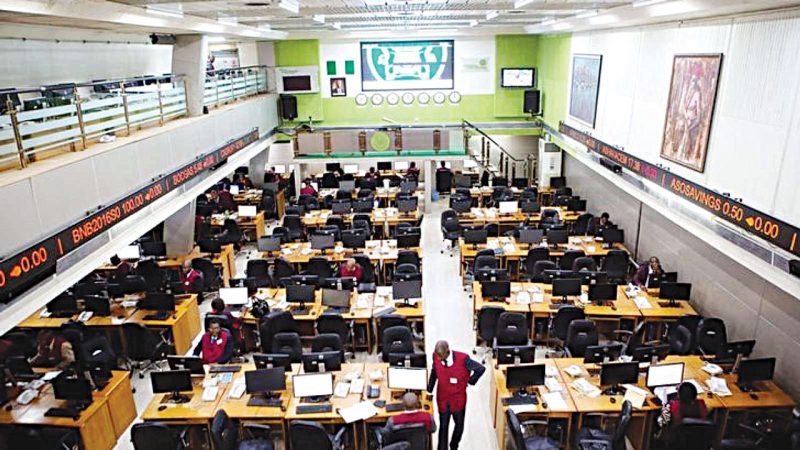



Allan Gray Ltd., the Cape Town-based money manager overseeing about $29 billion, prefers Nigerian equities to South Korean stocks. It sees Africa’s biggest oil producer as a way for investors to diversify away from the artificial-intelligence (AI) boom driving markets from New York to Seoul.
Nigeria’s rally has put it “in the same conversation” as South Korea’s Kospi, said Kamal Govan, who manages the firm’s $604 million Africa ex-SA Equity Fund, according to a Bloomberg report. Nigerian stocks make up nearly a third of the fund’s holdings.
The key difference, Govan wrote in a quarterly client note, is breadth.
The Kospi rally is “narrow and thematic, concentrated in two memory chip companies,” Samsung Electronics Co. and SK Hynix Inc. Together they make up about half the index and are benefiting from AI demand.
Nigeria’s advance, by contrast, “has been broad-based, spanning banks, oil and gas, telecommunications and industrial goods,” and is “underpinned by broader fundamentals rather than a single narrative.”
Nigeria Overtakes Korea
The NGX All-Share Index has climbed 72% in dollar terms this year, according to Bloomberg. That puts it on course for its best year since 2007 and ahead of the Kospi’s 54% gain.
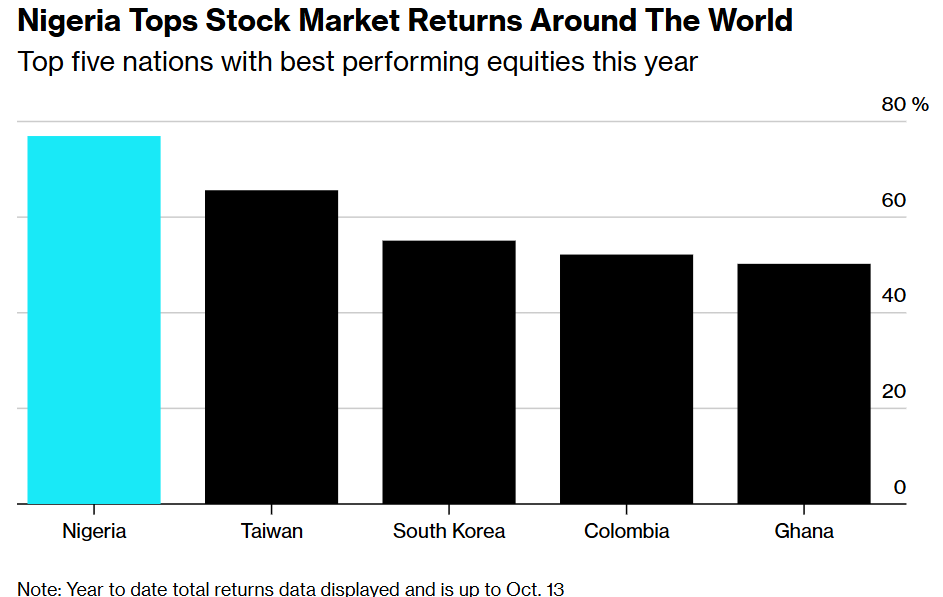
In naira, the index closed at 247,513.63 on October 13, up 59.06% from 155,613.03 at the end of 2025. The naira has strengthened to about N1,335.50 per dollar from about N1,435 at the end of last year. On MoneyCentral calculations, that lifts the index’s dollar return to about 71%.
Seplat and the Banks
Seplat Energy Plc is the fund’s main oil and gas holding. Its shares have risen 197% in dollar terms this year, putting it among the 11 best performers on the 151-member index. Small cap Zichis leads the market, up 706% Year-to-Date.
Allan Gray’s note says its bank exposure is concentrated in “the better-quality banks.”
The fund is up 29.3% this year in the note, against 7.5% for its MSCI benchmark, 11.7% for the MSCI World Index and 21.3% for the MSCI Emerging Markets Index.
FTSE Upgrade as Catalyst
FTSE Russell reclassified Nigeria from unclassified to frontier-market status from September 21. That reversed a downgrade three years ago over foreign investors’ difficulty getting their dollars out of the country.
“The FTSE Russell upgrade could provide a further catalyst through increased foreign participation and improved liquidity,” Govan said.
Other conditions are improving too. Gross reserves jumped to $58.8 billion on October 12, the highest since 2008. The central bank cut its policy rate by 350 basis points to 23% in September. T. Rowe Price has also called Nigeria attractive after its rally.
Risks
Allan Gray itself warns that “current levels of performance are exceptional and not necessarily sustainable over the long term.”
Foreign-investor returns also depend heavily on the naira. A reversal of this year’s appreciation would cut dollar gains even if share prices held.
 Follow the MoneyCentral Nigeria channel on WhatsApp: Click here!