



…as Rema Performs
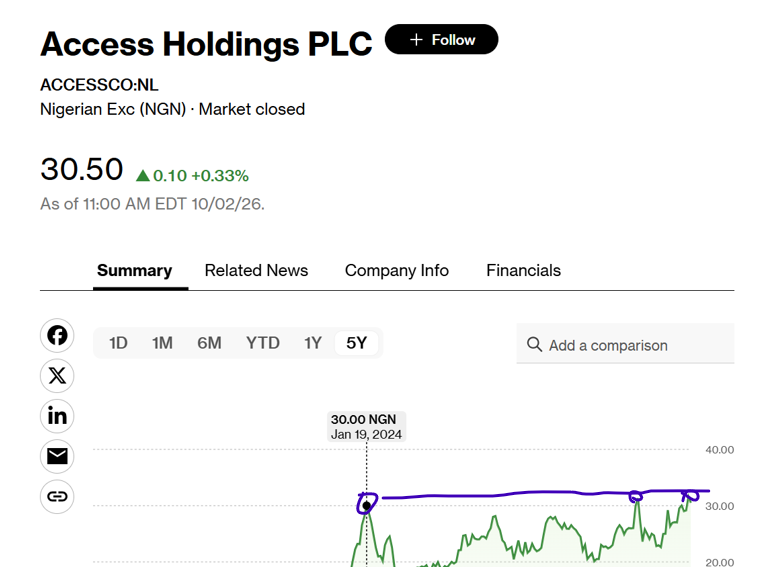
As Rema performed at Access Holdings Chairman Aigboje Aig-Imoukhuede’s 60th birthday celebration in London, investors in Nigeria’s largest bank by assets were confronting a less festive reality: Access shares have made little progress over three years and trade at the lowest valuation among the country’s biggest lenders.
Access Holdings shares have a 1-Year Return of +15%, compared with a +384% return for FirstHoldCo stock, +111.4% return for Zenith Bank, and a +53% return for Guaranty Trust Holding Company (GTCO) stock in the same time period.
Access Holdings has a market capitalization of about ₦1.65 trillion, compared with ₦2 trillion for United Bank for Africa, ₦4.85 trillion for Guaranty Trust Holding Co., ₦5.52 trillion for Zenith Bank and ₦6.82 trillion for FirstHoldCo, according to data compiled by MoneyCentral.
The valuation gap is striking because Access has built the country’s largest banking balance sheet through years of acquisitions, capital raising and geographic expansion.
Yet stock-market investors value the group at just 0.42 times book value, meaning the market prices its equity at less than half the carrying value on its balance sheet.
Access valuation problem
A price-to-book ratio below one does not automatically mean a bank is cheap. It can mean investors expect low returns on equity, are concerned about future asset-quality losses, question the sustainability of reported earnings or assign a discount for capital needs and execution risk.
At 0.42x book value, Access trades at a large discount to the value of its net assets. The market is effectively saying that the group must prove that its scale can produce durable cash returns for shareholders.
Access has spent years accumulating scale across Nigeria, Africa and other markets, while investing in technology, distribution, people and capital. The question is whether that investment phase is ending fast enough for shareholders to see higher dividends, stronger returns and a sustained share re-rating.
The promise of consolidation
At a fact behind the Rights Issue Presentation in July 2024, on the floor of the Nigerian Exchange (NGX) where Access is listed, Roosevelt Ogbonna, CEO of Access Holdings banking unit told investors that Access was close to finishing its growth and investment phase and by the first quarter (Q1) 2025, it will be consolidating for the future and there will be more dividend payout for shareholders.
Aig-Imoukhuede made the case more directly. He told shareholders that Access was forecast to earn about ₦17 per share annually and described the group as a “money-making machine” approaching a period when it would “start dropping money” for shareholders.
The rights issue was framed as an opportunity for existing shareholders to remain invested before the expected cash-flow and dividend phase arrived.
“We did a rights issue because it will be sad if our shareholders have gotten us so far, stayed with us through the thick and thin, through the times of investing, blood, sweat and tears, and then this money-making machine is about to start dropping money and then you are not a part of it. Don’t make that mistake,” Aigboje Aig Imoukhuede, the Chairman of Access Holdings Plc , said at the event.
More than two years later, shareholders are still waiting for tangible proof that the transition from expansion to payout has occurred.
Dividend question
Access has not paid a dividend since the 2024 fiscal year, according to data compiled by MoneyCentral. That leaves a gap between management’s earlier messaging and the shareholder experience.
The absence of a new dividend does not necessarily mean the group lacks distributable earnings. Banks can retain capital for regulatory requirements, expansion, loan growth, foreign subsidiaries, technology investment, acquisitions or anticipated credit losses.
But a group asking investors to support capital raising must eventually demonstrate why retained earnings create more shareholder value than cash distributions.
Access Holdings Plc, last week announced a further delay in releasing its audited interim financial statements for the half-yea rH1) period ended June 30, 2026.
In a corporate disclosure filed with the Nigerian Exchange (NGX) on October 2, 2026, Company Secretary Sunday Ekwochi confirmed that the NGX has granted the company a further deadline extension beyond the previously approved September 30, 2026 cutoff.
This provides more uncertainty for investors in the stock even as partying goes on in London.
Scale has not delivered a premium
Access’s low market capitalization relative to its tier-one peers shows that asset leadership alone has not convinced investors. The group has become Nigeria’s largest bank by assets, but the market continues to place a lower value on each naira of its book equity than it does on peers with smaller balance sheets.
The 0.42x price-to-book ratio is therefore not simply a verdict on Access’s assets. It is a judgment on the market’s confidence in how effectively those assets can be turned into returns.
The contrast: London party vs long-suffering shareholders
The performance by Rema at the Access Chairman’s London celebration is unlikely to determine investor sentiment.
The Afrobeats superstar Rema took the stage for an extended performance backed by a live orchestra.
However, it creates a sharp visual contrast with the concerns of retail and institutional shareholders who supported the group through years of acquisitions, recapitalization and expansion.
For those investors, the relevant performance is not on stage. It is the share price, earnings per share, dividend per share, return on equity, capital adequacy and the pace at which Access converts its large asset base into cash that can be retained or paid out.
Aig-Imoukhuede’s earlier message gave shareholders a simple proposition: stay invested through the difficult years of growth, and participate in the cash-generative phase that follows.
The investors and shareholders that listened to Mr. Aig Imoukhuede then, are still waiting to dance to the beat of the Access “money-making machine” rewarding their long-suffering, almost 3 years later.
 Follow the MoneyCentral Nigeria channel on WhatsApp: Click here!