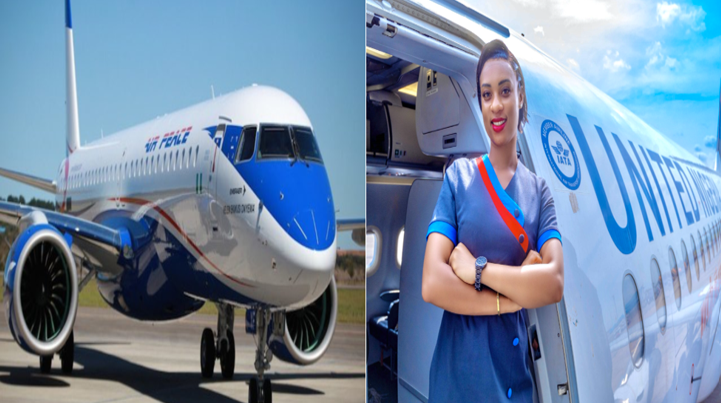



Air Peace Ltd. was Nigeria’s busiest airline in the first half of 2026, operating 7,687 flights, according to figures in a United Nigeria Airlines Co. investor presentation.
United Nigeria was a close second with 6,852. The two carriers ran more flights than the next four airlines combined, in a market hit by jet fuel prices that almost quadrupled within weeks.
The ranking appears in United Nigeria’s September 2026 presentation to investors for its N100 billion commercial paper programme. Ten carriers operated a combined 33,995 flights in the six months to June, according to MoneyCentral’s tally of the chart.
Air Peace and United Nigeria together accounted for 42.8% of them. The presentation does not present a source for the data.
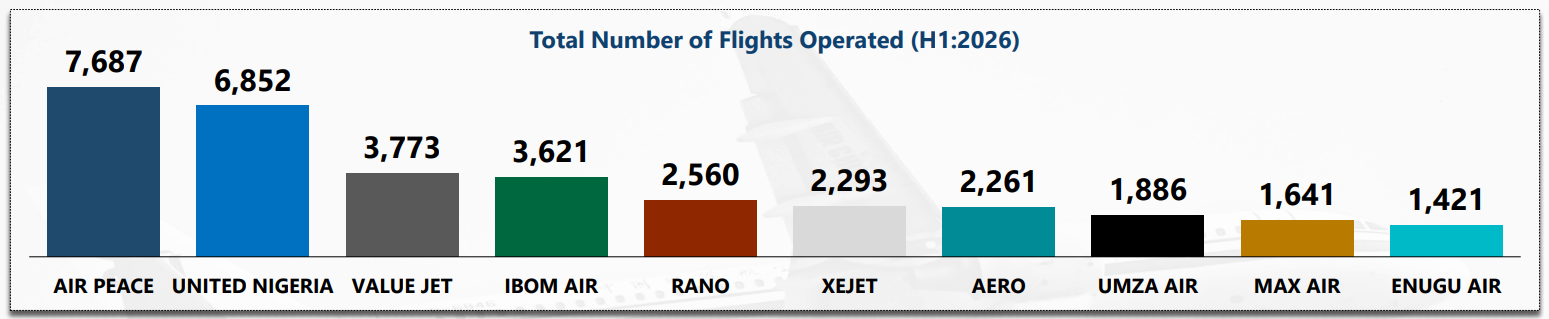
United Nigeria began operations in 2021 and now flies about 89% as many flights as Air Peace, which is far larger by fleet. United Nigeria operated 1.8 times as many flights as ValueJet, the third-ranked carrier. The top four airlines ran 64.5% of all flights. The bottom six each flew fewer than 2,600.
The market is concentrated but not dominated by one carrier, even as Air Peace has a lead in flight numbers but not enough to set prices on its own.
A Market Smaller Than It Looks
Nigeria has more than 200 million people but runs only about 190 domestic airline flights a day, based on the presentation’s ranking. The Nigeria Civil Aviation Authority recorded 7,961 domestic flights across 15 carriers in August, or about 257 a day.
According to the presentation, Nigerian airports handled 17.9 million passengers in 2025, up 5.9%, and 73% of them flew domestic routes.
Nigeria’s air transport and wider aviation sector contributes $2.5 billion annually to the country’s Gross Domestic Product (GDP), accounting for 0.7% of total national output, according to the International Air Transport Association (IATA).
International traffic is mostly carried by foreign airlines.
Five Nigerian carriers flew 285,023 international passengers in 2024, a 6.89% share of the market, according to NCAA data.
Qatar Airways alone had 12.84% and Ethiopian Airlines 11.13%. The presentation says domestic routes account for 73.7% of scheduled seats, leaving regional and international routes largely untapped.
Fuel Shock Crimps Airlines
Rising fuel costs dominated the first half as Jet A1 (aviation fuel) rose from about N900 a litre in late February to as much as N3,300 by mid-April after the US-Israel strikes on Iran.
Nigerian Airline operators threatened a nationwide shutdown from April 20, due to the spike in jet fuel. Air Peace founder Allen Onyema said a flight that once needed N3 million of fuel now costs N12 million to N13 million.
Airlines responded by cutting capacity and raising fares. Air Peace has parked about half of its 16 mainline Boeing jets, including a 777-300, and is relying on its smaller Embraer regional fleet.
Rano Air suspended some routes, while one-way economy fares on routes such as Lagos-Owerri have risen above N200,000, from about N150,000 four months earlier.
Dangote Petroleum Refinery has since cut its Jet A1 price to N1,650 a litre, which is still almost double the pre-war level.
United Nigeria’s own accounts show the cost of growing through the shock. It carried more passengers in the first half than in all of 2025, but lost N13.35 billion, and its borrowings rose to N115.5 billion as it bought new aircraft.
 Follow the MoneyCentral Nigeria channel on WhatsApp: Click here!