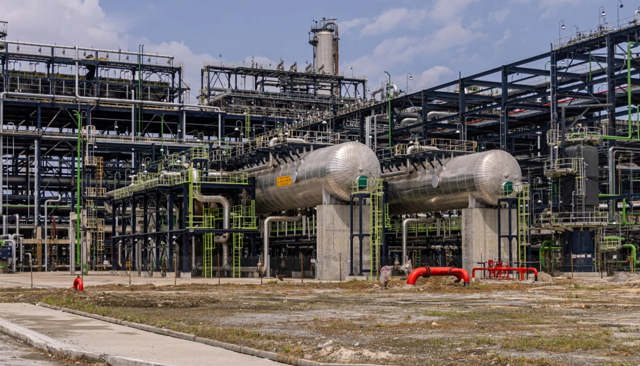



Aliko Dangote has started work to double capacity at his huge oil refinery in Nigeria, which when finished will rival the world’s largest site and give Africa’s richest person a stronger grip on global fuel supply chains.
Dangote Group has begun construction at the Lekki site on a new facility that will process 700,000 barrels a day of crude oil, according to David Bird, CEO of Dangote Petroleum Refinery & Petrochemicals. It will be online by the end of 2028 and bring the complex’s total capacity to a massive 1.4 million barrels a day.
The existing refinery has had a big impact on global fuel markets, allowing Africa’s most populous country to cut its dependence on imports of refined products like gasoline. It has also helped shield Nigeria from Iran war-related supply shocks and provided crucial jet fuel cargoes to Europe to ease a crunch there. A larger site will open up more export and trading opportunities.
“Piling and site preparation is already well underway,” Bird said in an interview on the sidelines of S&P Global’s Middle East Petroleum & Gas Conference in London. “We will have steel coming out of the ground by the end of the year.”
Global scale
Dangote has already announced plans to increase the current plant’s 650,000 barrels-a-day capacity to 700,000 barrels a day. Together with the new facility, the total capacity would be more than three times larger than Europe’s top refinery and match that of Reliance Industries Ltd.’s Jamnagar facility in India, the world’s biggest single-site complex.
Dangote sold the idea of the current plant as a way for Nigeria, the continent’s top oil producer, to stop sending barrels to Europe only to be refined and shipped back as costly imports. The opening of the facility outside Lagos was announced in 2023, seven years late, with operations starting in early 2024.
Execution timeline
“Will it appear and will it operate successfully? Yes,” said Alan Gelder, senior vice president for refining, chemicals and oil markets at consultancy Wood Mackenzie Ltd. “Will it be early 2029? The probability of that is quite low as it needs everything to go perfectly. And it’s still a very large project.”
Bird, however, is keen to emphasize that the knowledge gained through building the first plant will help in building the second. “Everyone would say, how the hell do you think you can bring on 700,000 barrels of fully complex refining capacity in three years?” Bird said. The answer is “ruthless replication” of the existing facility’s design.
East Africa expansion
The existing refinery’s output ramped up in recent years, helping Nigeria to make more fuel domestically. That’s prompting other African nations to lure the group’s billionaire owner. In a separate project, Dangote is looking to replicate his Nigerian facility in East Africa, with Kenya’s president recently stating a refinery would be located in his country.
If that goes ahead, it would make Dangote an even bigger player in international fuel markets and open up significant oil-trading opportunities. The Nigerian facility already exports petroleum products all over the world and its operations, particularly its key gasoline unit, are closely monitored by traders. Assuming the East African plant is a replica of the existing Nigerian one, the planned expansions would take Dangote’s processing capacity to about 2 million barrels a day, roughly the equivalent of Germany’s entire oil demand.
“We’ll continue to grow our trading capability,” Bird said. “Even more so in light of the extra trade flows from expansion, and, East Africa.”
Chance to reshape global refining
The expansion positions Dangote to become a dominant force in global refining, with capacity matching India’s Reliance Jamnagar—the world’s largest single-site complex. The “ruthless replication” strategy should reduce engineering time and execution risk, though Wood Mackenzie’s Gelder cautions that 2028 completion is optimistic given the project’s scale.
If the East African plant materializes, Dangote’s total capacity could reach 2 million b/d, giving the conglomerate unprecedented influence over global fuel flows and trading opportunities.
The Nigerian facility has already transformed Africa’s fuel trade by ending the continent’s paradox of exporting crude only to import refined products. With the expansion, Dangote could reshape global refining dynamics and establish Africa as a major refining hub.
 Follow the MoneyCentral Nigeria channel on WhatsApp: Click here!